

When you are looking for bilingual support resources for domestic abuse cases, information in a language you understand well can help you see your options more clearly. Even so, different resources serve different purposes: some explain rights and services, whilst others offer telephone support or tailored guidance for your situation.
It is entirely natural not to know where to begin. You might want to read in Romanian, double-check the information in English, or talk to someone, whilst wondering what happens after you ask for help. If someone else might check the device you are using, the safety of opening a webpage or contacting a service can be an important concern.
In this guide, you will be able to compare resources available in Romanian and English and learn what each can offer: written information, support helplines, or one-to-one guidance. You will also find a few points to check regarding your data before contacting a service. This way, you can take a step that suits your circumstances, without any pressure to make an immediate decision.
Key Takeaways
- Choose bilingual support resources for domestic abuse cases based on what you need right now: information, telephone support, or one-to-one guidance.
- Compare the purpose, language, format, and cost of each resource to understand what kind of help it provides.
- Check who publishes the information, when it was updated, and how you can contact the organisation.
- Start with the specific question you have. Choose the right format and ask for guidance if the information is not clear to you.
- Lotus Justice and Support Centre provides free bilingual resources, downloadable guides, and signposting to relevant services.
What are bilingual support resources in domestic abuse cases?
Bilingual resources provide information or services in Romanian and English. Bilingual support resources for domestic abuse cases can help you understand your options without forcing you to make an immediate decision. If English is not the language you feel most comfortable with, official forms and statutory information can be harder to follow.
A guide offers general information, whilst one-to-one guidance focuses on your specific questions and needs. A general resource cannot determine on its own which option is right for you.
What can a bilingual resource include?
It might be a guide explaining services and general steps, a support helpline, or a digital tool that provides information. Some materials also explain what a women's refuge is, without confirming whether a specific service is available or suitable for you. You can browse Lotus resources and guides at your own pace.
What can an informational resource not replace?
A guide does not replace individual legal advice, and online information is not emergency help. If you are in immediate danger, call 999. If you cannot speak, press 55 when prompted.
What type of bilingual resource suits your need?
Not every resource offers the same kind of support. If you want to understand information at your own pace, a guide can be a sensible place to start. If you need to discuss your circumstances or find out which service you can turn to, a helpline or one-to-one guidance may be more helpful. Bilingual support resources for domestic abuse cases can serve different functions, even though they all aim to make information more accessible.
Guides and downloadable materials
Guides explain services, rights, and general steps. You can read them at your own pace and return to any section whenever you need. Before relying on a document, check who published it, when it was updated, and whether it is available in the language you understand best. Lotus resources and guides include bilingual informational materials.
Helplines and digital tools
A digital tool can provide information when you use it, but it is not a conversation with a person. A helpline allows you to speak with someone and ask for direction. Lotus offers a freephone helpline and a multilingual digital assistant, designed for the Romanian-speaking community. These channels can help you understand information and options, without guaranteeing a particular outcome.
Statutory services and community resources often have different responsibilities and types of support. A community resource can help you understand where to turn, whilst the relevant statutory service can address a specific statutory need. To discuss your questions and explore possible next steps, you can request guidance from Lotus.
One-to-one guidance
When general information does not clarify what suits your situation, you can ask for guidance regarding your specific question. You do not need to have all the details prepared. You can start simply by explaining what is unclear or what kind of support you are seeking.
Choose the channel you feel comfortable with and check whether it is safe for you to use. If you are in immediate danger, informational resources cannot replace the emergency services: call 999. If you cannot speak, press 55 when prompted.
How to compare bilingual resources before using them?
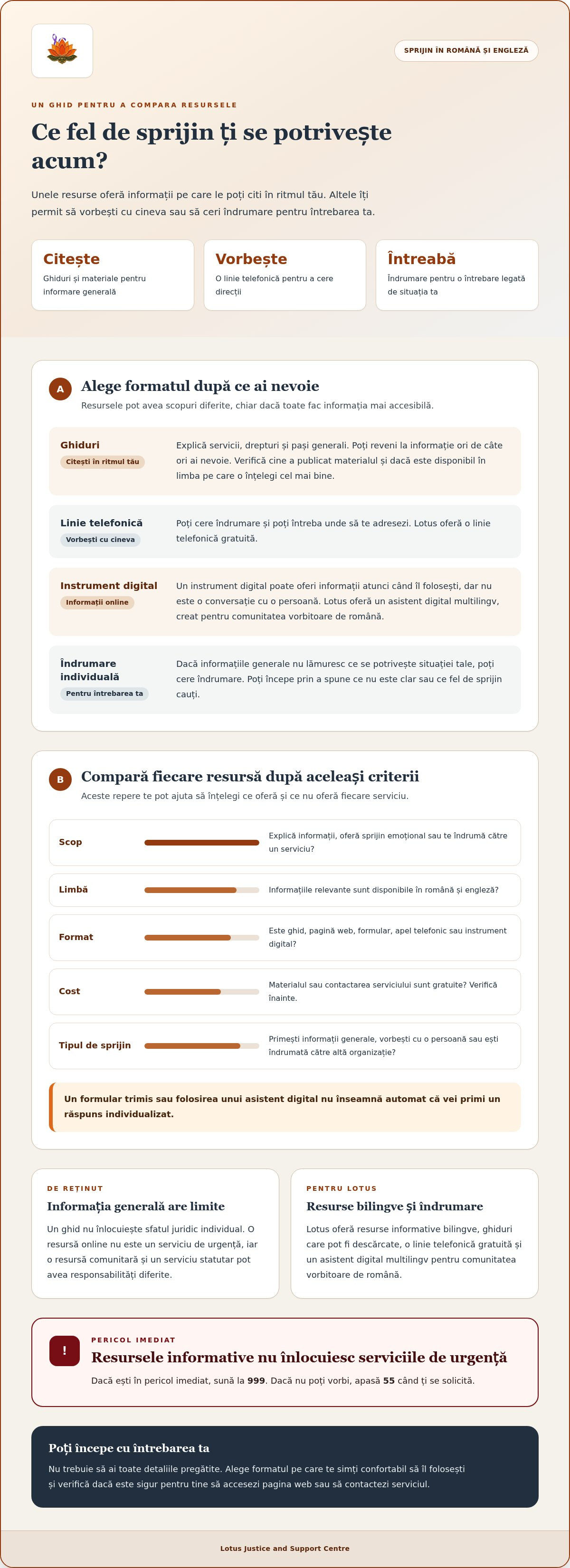
When you find several options, compare them using the same criteria. This helps you see whether you need general information, emotional support, or direction towards a service. Bilingual support resources for domestic abuse cases may have different purposes and limitations, even if they appear on similar websites.
For each resource, make note of:
- Purpose: does it explain information, offer emotional support, or direct you to a service?
- Language: is the relevant information fully available in Romanian and English?
- Format: is it a guide, a webpage, a form, a telephone call, or a digital tool?
- Cost: is the material or contacting the service free of charge? Check beforehand rather than assuming.
- Type of support: do you receive general information, speak with a person, or get signposted to another organisation?
Submitting a form or using a digital assistant does not automatically mean you will receive an individualised response. Check what kind of help the service provides and whether it explains the next steps.
What should you check regarding language, access, and cost?
Check whether all relevant sections are available in Romanian, not just the title or a small section of the page. Look for the name of the organisation that published the material and the date of the latest update. Outdated information may not reflect current services or statutory guidance.
Consider also how you will access the resource. If you are reading on a phone, is the page easy to navigate? If the device might be monitored, consider whether it is safe for you to open the page or contact the service. You do not have to use a specific channel if you do not feel safe doing so.
How do you understand confidentiality and service boundaries?
Before submitting personal data, read the privacy policy and check what information is requested, how it is used, and whether it may be shared with other organisations. Personal data is processed in accordance with UK GDPR, and information in public reporting is anonymised. These measures do not constitute an absolute guarantee of confidentiality.
Distinguish between general information, emotional support, and legal guidance. A guide can explain a topic, whilst a conversation can offer listening and direction. Legal guidance can help you understand certain options, but it is not the same as representation in court. Statutory and community services have different roles, and some may direct you to another organisation.
If you would like to discuss what kind of support you are seeking, you can request guidance from Lotus. The information and guidance service is free of charge.
How to use resources without losing sight of safety?
You can search for information step by step, without needing to resolve everything at once. Start with a practical question, such as: "What kind of support is available?" Then choose the appropriate format: a guide for general information or a conversation for guidance. Check who published the resource and what type of help it provides. If the information does not answer your question, you can ask for guidance.
Choose a channel that you consider accessible and safe. If you are using a device that might be monitored, think about whether it is suitable to access the resource from that device. You do not have to explain everything all at once, and you are under no obligation to make an immediate decision.
What should you do when you do not know where to begin?
Start with the question that matters most to you right now. It could be about a service, about where to ask for support, or about some information you have read. You can choose to read, use a digital tool, or speak with someone, depending on what feels easiest and safest for you.
For a broader overview of support options, you can consult the complete guide to help in the United Kingdom. Bilingual support resources for domestic abuse cases can clarify information, but they do not replace guidance tailored to your situation.
If you are considering leaving, safety planning with a specialist worker is essential. Risk is often highest at the point of separation, and a specialist can help you think through safety and suitable options. Do not rush into acting without a safety plan.
What should you do if there is immediate danger?
If you are in immediate danger, call 999. Do not wait for a response to an online form or message when you need urgent help. The operator speaks English, but you can request an interpreter in Romanian. If you call 999 and cannot speak, press 55 when prompted.
How can Lotus help you find the next step?
Lotus Justice and Support Centre provides free information and guidance for the Romanian-speaking community in England and Wales. If information in English is difficult to understand or you are unsure which service to contact, you can ask for help to clarify the available options.
Support can include information on services and rights, legal guidance, emotional support, and signposting to relevant services. You can ask for information about areas such as immigration and family law, or guidance on housing, benefits, healthcare, employment, and consular matters. The right type of support depends on your question and your circumstances. Guidance can help you understand options, without guaranteeing a particular outcome or legal remedy.
Which Lotus channels can you use?
You can contact Lotus through the online form to request help or call freephone on 0800 098 2730. The digital assistant provides information in Romanian, but it is not an emergency service and does not replace guidance tailored to your circumstances.
Before submitting personal details, read the privacy policy and consider whether it is safe for you to use your chosen device or channel. You can begin with the question that concerns you most.
What should you expect from guidance?
Guidance can help you understand what types of support exist and which relevant services you might approach. Lotus provides information and guidance, not direct representation in court. The organisation does not run its own emergency refuge and does not provide direct financial assistance or loans.
You can start the conversation at your own pace, without any expectation of a specific outcome. Urgent enquiries are prioritised for a response within 48 hours. The form and telephone line do not replace emergency services.
You can use the form at lotusjusticeapp.co.uk/cere-ajutor or call freephone on 0800 098 2730.
Choose a support step that is right for you
Bilingual support resources for domestic abuse cases can help you understand information and compare what each service offers. Check the language, purpose, and limitations of the resource. A guide explains general information, whilst guidance can help you explore options suited to your situation. You do not have to make an immediate decision.
Lotus Justice and Support Centre provides free information and guidance for the Romanian community in England and Wales. You can contact the team via the form or on the freephone line 0800 098 2730. The digital assistant provides information in Romanian, but does not replace emergency services.
You can start with a single question and choose the next step at your own pace.
Frequently asked questions about bilingual support resources
What bilingual resources exist for domestic abuse support in the United Kingdom?
You can find guides in Romanian and English, support helplines, digital tools, and one-to-one guidance services. Some explain general information, whilst others can signpost you to relevant services. Statutory and community organisations have different roles, so check who provides the support and what it entails. Bilingual support resources for domestic abuse cases can help you understand your options in your preferred language.
Is support provided by Lotus Justice and Support Centre free of charge?
Yes, Lotus information and guidance are free of charge. You can call the freephone line on 0800 098 2730 or use the online form. Urgent cases are prioritised for a response within 48 hours. If you have questions about what a particular type of support involves, check the details directly with the organisation before sending personal information.
Can I use a bilingual guide instead of individual legal advice?
No, a bilingual guide provides general information and does not replace legal guidance tailored to your situation. You can use it to understand terms, services, or general steps, and to prepare the questions you wish to ask. If you need help with a personal legal issue, ask for individual guidance. A guide cannot determine which option suits you best and cannot guarantee a particular outcome.
Is it safe to seek help online if my device is monitored?
Using a monitored device cannot be guaranteed to be safe. Before visiting a page or submitting a form, consider whether your online activity could be seen by someone else. If possible, use a device or channel that you consider safer. Do not send personal data if you do not feel safe doing so. In case of immediate danger, do not wait for an online response, call 999.
Can I contact Lotus if I am not ready to make a decision?
Yes, you can ask for information or guidance without being ready to make a decision. You can start with a single question and explain only what you feel comfortable sharing. The discussion can help you understand which options or services might be relevant, without obliging you to take a specific step. Choose a contact channel that you consider accessible and safe for you.
What do I do if I am in immediate danger and cannot speak?
Call 999 and press 55 when prompted. This signal tells the operator that you need help. Do not wait for a reply to a form, a message, or from a digital tool if urgent intervention is needed. If you can speak, the operator speaks English, and you can request an interpreter in Romanian. Use these instructions only for emergencies.
What information does the Lotus digital assistant provide in Romanian?
The Lotus digital assistant provides information in Romanian about rights, benefits, and services. You can use it to clarify a question or find out what types of resources might be relevant. It is an informational tool, not a person providing automated individual guidance, and not an emergency service. To discuss your situation, you can use the Lotus form or call freephone on 0800 098 2730.

Disclaimer
The information on this blog is general and educational. It does not constitute individual legal, medical or psychological advice and is not a substitute for support from a professional who knows your circumstances.
If you are in immediate danger, call 999. If you cannot speak, press 55 once connected.
For free, confidential support in Romanian, use the form at lotusjusticeapp.co.uk/cere-ajutor or call 0800 098 2730. We respond within 48 hours.
Online safety: if you are using a device the abuser can access, clear your browsing history or use a private window. You can also access this site from a public library, from work or from the phone of a trusted person.
Lotus Justice & Support Centre CIC, registered company in England and Wales no. 17184809. ICO registration ZC144429.
