

A course title alone does not tell you whether training is suitable for your role. How can you choose a professional training module in domestic abuse without making assumptions about what the course or certificate delivers?
Start by checking the intended audience, the syllabus, and the educational aim. Next, compare the published details and clarify any missing points directly with the provider. This allows you to evaluate whether the training aligns with your responsibilities and learning objectives.
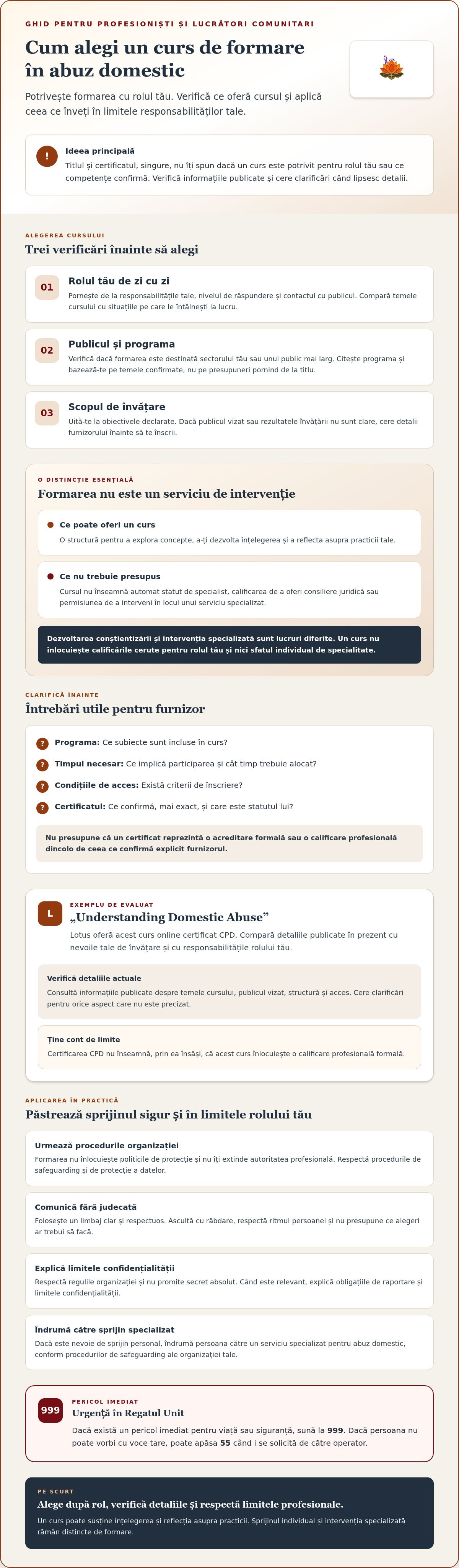
Below, you will find criteria to help you choose, guidance on applying your learning within professional boundaries, and confirmed information about the Lotus course "Understanding Domestic Abuse".
Key Takeaways
- Choose a domestic abuse professional training module based on your day-to-day responsibilities, not solely on the course title.
- Check the confirmed topics, intended audience, and published information regarding structure and access.
- Ask the provider about the syllabus, required time commitment, and entry criteria. Never assume what the certificate covers or confirms.
- Apply what you learn strictly within the limits of your professional role, and follow organisational safeguarding procedures when signposting someone to support.
- Weigh the Lotus CPD-certified online course "Understanding Domestic Abuse" against your learning needs, keeping in mind that it does not replace a formal professional qualification.
What is a domestic abuse professional training module?
A domestic abuse professional training module is a focused learning unit designed to deepen understanding of the issue and show how that knowledge can support prevention and safer, more attentive practice. It can form part of a broader programme or be completed as a standalone unit, depending on what the provider offers. The word "module" on its own does not tell you what is covered, how long it takes, or the standing of any certificate. You should always check these specifics in the published course description.
Professional training can build your awareness so you can respond more effectively, but it does not replace the statutory qualifications needed for your role, nor does it substitute for individual specialist advice. For a broad overview of professional and community approaches, you can read this overview of domestic abuse management. It offers helpful context, although it does not dictate a syllabus or override your organisation's policies.
It helps to distinguish between three different things. Awareness gives you knowledge to understand the dynamics of abuse. Skills development aims to strengthen how you carry out your existing duties, although what you can practise depends on the training content and your professional remit. Direct support services, such as safety planning or casework with someone affected by abuse, are entirely separate from training and must be delivered by specialist organisations. A training course is never an intervention service in itself.
Who might benefit from this training?
Training can be valuable for professionals working across healthcare, social services, and legal settings, as well as community practitioners. Volunteers and community workers supporting Romanian-speaking residents can use this knowledge to clarify how to respond calmly and when to signpost someone to specialist help. Needs naturally vary: your role, level of responsibility, and direct contact with the public will determine which course suits you best.
What can a course provide, and what can it not?
A course can provide a structure to explore key concepts and reflect on your practice. However, you should not assume that completing it gives you specialist practitioner status, qualifies you to give legal advice, or allows you to intervene in place of dedicated domestic abuse services. Similarly, certification should never be treated as formal accreditation beyond what the provider explicitly confirms. Check what the certificate covers and speak with your employer about your boundaries so you can apply your learning safely.
What should you learn from domestic abuse training?
A good course will help you understand the realities of domestic abuse and reflect on how to respond appropriately within your remit. Always look at the current course syllabus and rely on confirmed topics. Never assume that a general title guarantees specific case studies, practical exercises, or formal outcomes.
Developing awareness helps you recognise what is happening, whereas specialist intervention involves tailored, individual casework delivered by qualified services. A domestic abuse professional training module does not authorise you to carry out specialist risk assessments or intervene outside your role. Check whether the course outline clearly states its target audience and learning goals. For the Lotus course "Understanding Domestic Abuse", review the current published details.
How do you identify content relevant to your role?
Start with your day-to-day responsibilities. Compare the syllabus topics with situations you encounter at work, and check whether the course is aimed at practitioners in your specific sector or a broader audience. If the outline is vague about learning outcomes or target participants, ask the provider for clarification before signing up. Always review your workplace safeguarding policies: training can never replace them or expand your professional authority.
In all interactions, use clear, respectful, non-judgemental language. Never imply that someone is to blame for what is happening to them, and avoid assuming what choices they should make. Listen patiently and respect their pace. Follow your organisation's data protection and confidentiality protocols, and never promise absolute secrecy. Where relevant, explain clearly what your reporting obligations and confidentiality limits are.
How do you approach conversations with care and respect?
If someone needs personal support, refer or signpost them to a specialist domestic abuse service in line with your organisation's safeguarding procedures. If there is an immediate danger to life or safety in the UK, call 999. If the person cannot speak aloud, they can press 55 when prompted by the operator.
If you are supporting a Romanian-speaking individual and need guidance on next steps, you can consult the Lotus help request page.
How do you compare domestic abuse professional training modules?
When selecting a training module, compare verifiable facts and educational aims rather than relying on promotional titles or career claims. Apply the same objective criteria to every course you review. If key details are missing, contact the provider before committing.
| Aspect to compare | What to check | The Lotus course |
|---|---|---|
| Target audience | Who is the course designed for, and which professional roles does it suit? | Confirmed in the current published course description. |
| Format | Is it online, in-person, or blended? How is material accessed? | Confirmed as an online course. |
| Certification stated | What certificate is awarded, and what does it specifically confirm? | Presented as a CPD-certified course. |
| Verifiable details | Where can you see the syllabus, time commitment, and entry criteria? | Check the latest published information directly with the provider. |
Avoid making assumptions where details are missing. For example, knowing a course is online does not tell you the total study hours required. Similarly, a CPD label does not mean the training is equivalent to an accredited qualification. Always compare what the provider clearly states against your practical learning needs.
What questions should you ask before enrolling?
Ask for the current course outline and clarify who the module is written for. Find out what completion document you will receive and what the CPD recognition entails, without assuming it will be accepted across all regulatory bodies. Check the format, access arrangements, expected study hours, and any entry requirements directly with the provider. Then compare those details with what you actually need to learn for your work.
How do you check whether a CPD course suits you?
The confirmed details for the Lotus course "Understanding Domestic Abuse" are that it is delivered online and is CPD certified. Review the current course webpage for published information, and reach out to Lotus if any questions remain. Remember that a CPD certificate is not an accredited professional qualification, a promise of employment, or permission to undertake casework beyond your remit.
Base your choice on the knowledge you need to acquire and the boundaries of your current position. A careful comparison ensures you know what is confirmed, what requires clarification, and whether the module meets your expectations.
How do you apply your learning without exceeding professional boundaries?
Training provides a framework for reflection, but putting it into practice begins with a simple question: what falls within my professional remit, and what should be referred to specialists? Before applying what you have learnt, clarify your role, review your workplace policies, and seek safeguarding supervision whenever in doubt. Maintain professional limits at all times. Never present general information as bespoke legal advice, and never promise that a specific course of action will achieve a particular outcome.
A domestic abuse professional training module helps you offer a more informed initial response, but it does not replace statutory procedures or dedicated specialist casework. If you are interested in the Lotus online CPD-certified course "Understanding Domestic Abuse", review the published syllabus and request further details if needed.
How do you handle a sensitive disclosure responsibly?
Listen without judging and allow the person to share at their own pace. Do not press them for details, rush them into making decisions, or urge them to accept an intervention they do not want. You can ask what help they would find useful and explain, gently, what you are able to do within your role. Never promise absolute confidentiality. Follow your organisation's safeguarding protocols and explain them transparently. When individual support is needed, refer the person to a specialist domestic abuse service.
What should you do if there are safety concerns?
Never advise someone to confront an abuser, record conversations, or gather evidence covertly. If separating or leaving is discussed, keep in mind that the risk of harm is highest around the point of separation. Safety planning alongside a specialist worker is essential. Never encourage an abrupt departure without a structured safety plan in place.
If there is immediate danger in the UK, call 999. If the person cannot speak aloud, they can press 55 when connected. For non-urgent situations, follow your organisation's internal referral pathways and consult a specialist domestic abuse organisation. This allows you to provide supportive, compassionate contact without taking on responsibilities that belong to dedicated services.
The Lotus CPD-certified course: how to know if it meets your needs?
Lotus Justice & Support Centre offers the online CPD-certified course "Understanding Domestic Abuse". It can be a helpful learning option if you wish to deepen your understanding of domestic abuse dynamics. However, whether it is right for you depends on your learning objectives and the nature of your role. CPD certification should not be confused with a formal qualification and does not, in itself, guarantee career progression.
Before enrolling, review the current course information. If any detail is unclear or missing, seek direct confirmation from Lotus. Do not assume the syllabus, duration, cost, credit value, entry criteria, or outcomes based purely on the course title.
What course details should you confirm directly?
Compare the current course outline with the specific competencies you wish to develop. You can ask for clarification on the syllabus, access arrangements, and what the CPD accreditation specifically entails. It is also wise to check whether enrolment criteria and fees remain current. These questions will help you make an informed decision without attributing unconfirmed claims to the course.
A professional training module supports your development, but it cannot substitute for statutory qualifications or specialist casework. The course must not be viewed as legal representation or crisis intervention. If you are supporting an individual, follow your organisation's procedures and connect them with qualified services for personalised support.
How can you request information or support from Lotus?
If you need support or guidance, you can submit an enquiry via the Lotus help request form or call freephone 0800 098 2730. Enquiries are responded to within 48 hours. For course queries, check published materials and request details directly from the Lotus team.
If you or someone you are supporting is in immediate danger, call 999 for police, ambulance, or fire services. If you cannot speak aloud, press 55 when prompted.
Choose training with clarity and confidence
Select a domestic abuse professional training module based on its clear educational purpose and how it fits your working role, not simply on its title. Confirm the syllabus, target audience, and certification details directly with the provider. Always follow your workplace safeguarding procedures and signpost to specialist services whenever a situation goes beyond your remit.
Lotus offers the online CPD-certified course "Understanding Domestic Abuse". If you would like to discuss whether the course aligns with your aims, or if you need guidance on supporting someone, get in touch with our team.
You can complete the enquiry form above or call freephone 0800 098 2730. We aim to respond within 48 hours. If there is immediate danger, dial 999; if you are unable to speak, press 55 when prompted. An informed, thoughtful step forward helps ensure safe, responsible support for everyone involved.
Frequently Asked Questions
What is a domestic abuse professional training module?
A domestic abuse professional training module is a structured unit of study focusing on domestic abuse awareness, prevention, and safe responses. Syllabus content varies between providers, so you should always check the detailed outline. While training builds valuable knowledge, it does not replace the formal qualifications required for specialist roles, nor does it replace individual support services.
Who can benefit from domestic abuse training?
Training can be useful for healthcare staff, social workers, legal professionals, community workers, and volunteers who support the Romanian-speaking community. Relevance depends on your role and how often you work with the public. Before choosing a course, confirm that the provider clearly states the target audience and that the learning aims match your work.
What does it mean if an online course is CPD certified?
CPD stands for Continuing Professional Development. A CPD certificate indicates that the training counts towards your ongoing professional learning hours as defined by the provider. You should check what the certificate confirms and who recognises it. Do not assume that CPD certification automatically equals an accredited academic qualification or guarantees career advancement.
How do I know if a domestic abuse course suits my role?
Compare the published syllabus and stated learning aims with the situations you handle in your practice. Check the target audience, format, time commitment, and enrolment requirements directly with the provider. If the published description does not answer your questions, seek clarification before enrolling and discuss the training with your manager or safeguarding lead.
Can a training course replace specialist casework or professional supervision?
No. A course builds personal knowledge and awareness, but it does not replace accredited qualifications, workplace safeguarding procedures, or personalised support for someone experiencing abuse. CPD certification does not authorise you to carry out specialist risk assessments or interventions outside your remit. When an issue exceeds your role, follow your organisation's procedures and signpost the person to specialist services.
What is included in the Lotus course "Understanding Domestic Abuse"?
Check the current course webpage or contact Lotus directly for full details regarding the syllabus, access, and CPD accreditation. The confirmed information is that "Understanding Domestic Abuse" is an online, CPD-certified course. Do not make assumptions about specific units, duration, credits, or professional recognition unless they are explicitly stated by Lotus.
How can I request free information or support from Lotus Justice?
You can send an enquiry via the Lotus help request form or call freephone 0800 098 2730. If someone is in immediate danger in the UK, call 999 for the police, ambulance, or fire service. If you cannot speak out loud, press 55 when prompted.

Disclaimer
The information on this blog is general and educational. It does not constitute individual legal, medical, or psychological advice and is not a substitute for support from a professional who knows your circumstances.
If you are in immediate danger, call 999. If you cannot speak, press 55 once connected.
For free, confidential support in Romanian, use the form at lotusjusticeapp.co.uk/cere-ajutor or call 0800 098 2730. We respond within 48 hours.
Online safety: if you are using a device the abuser can access, clear your browsing history or use a private window. You can also access this site from a public library, from work, or from the phone of a trusted friend.
Lotus Justice & Support Centre CIC, registered in England and Wales no. 17184809. ICO registration ZC144429.
