

Did you know that, under British law, custody is not a right you hold over your child, but an immense responsibility that the state strictly monitors to ensure the child's welfare? This perspective can seem intimidating, especially when you feel vulnerable. You probably feel overwhelmed by the thought that a language barrier or unfamiliarity with procedures could make you lose what you hold dearest. It is natural to feel deep anxiety about the role of Social Services or how child custody works in the UK family court for a Romanian mother, especially when your safety is at risk.
We want you to know that you are not alone in this process, and correct information is your most powerful weapon. In this guide, you will learn how to navigate the UK family justice system to protect your safety and that of your children, transforming fear into informed action. We will go through the legal steps in England and Wales together, ways to access bilingual support, and the necessary steps to create a vital safety plan before separation.
Key Takeaways
- You will understand how the child custody process works in the UK family court for a Romanian mother, focusing on the child's best interests and your safety.
- You will learn the difference between parental responsibility and living arrangements, essential aspects for clarifying your legal rights and obligations in England and Wales.
- You will discover how a history of domestic abuse influences a judge's decisions and why it is vital to have a safety plan before initiating separation.
- You will find out how you can access free legal aid and bilingual support to overcome language barriers when dealing with British authorities.
- You will explore the criteria used by the court to assess your child's emotional and physical needs during family legal proceedings.
The Family Court in the UK: What a Romanian Mother Needs to Know
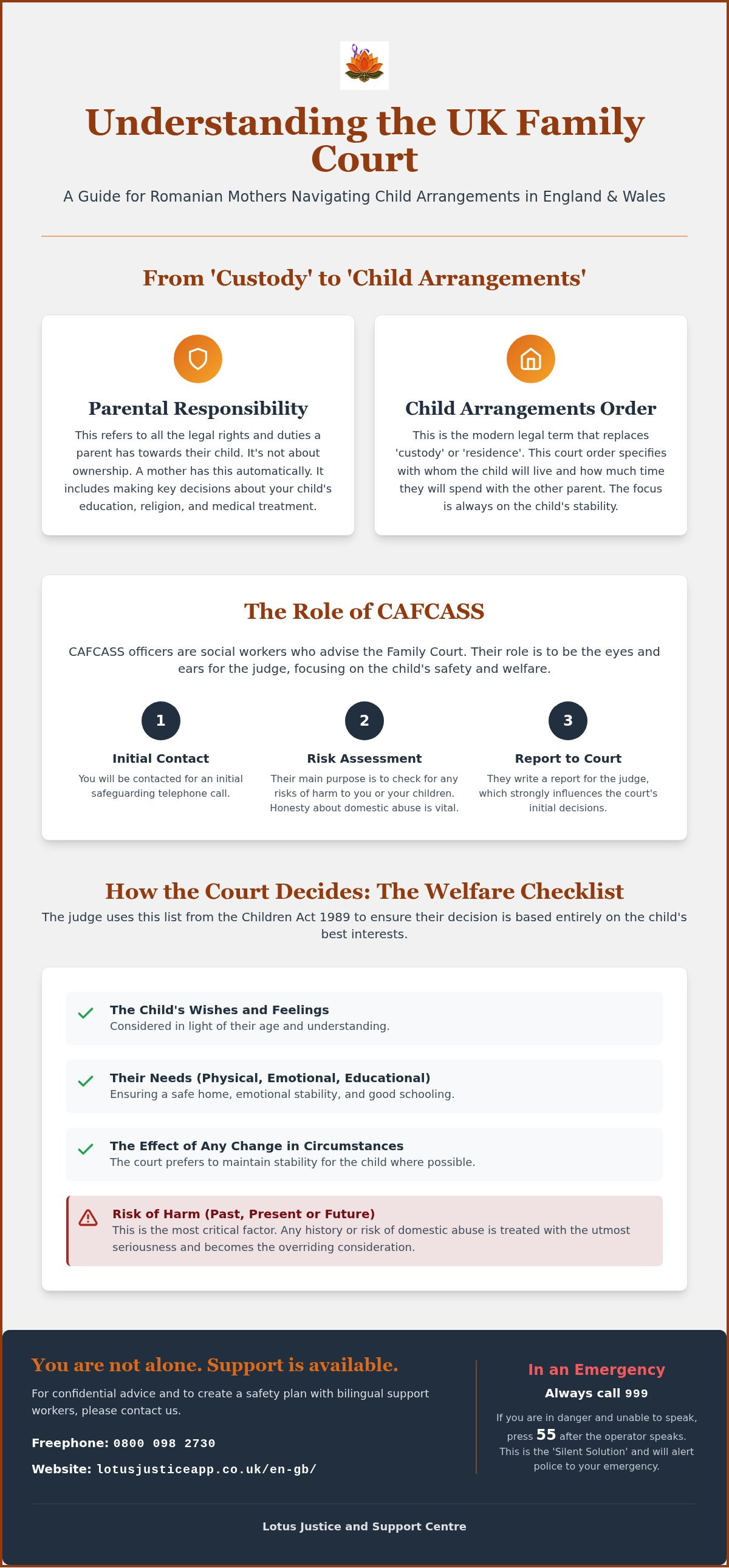
The justice system in England and Wales operates on principles that may seem very different from those in Romania. If you are in a situation where you need to discuss child custody in the UK family court as a Romanian mother, the first thing you need to understand is that the judge is not looking to side with one parent or another. The court's role is exclusively to ensure a safe and stable environment for your child. The central philosophy of British legislation, established by the Children Act 1989, is the child's best interests. This means that your child's needs are prioritised over any adult's wishes. The court makes a clear distinction between who has legal responsibility and the practical living arrangements, focusing on the child's emotional stability.
Parental Responsibility in the British System
In the UK, the term 'custody' has been replaced by more nuanced concepts. The most important is Parental Responsibility. This represents the totality of rights and obligations a parent has towards their child. A mother automatically holds this responsibility. A father obtains it if he is named on the birth certificate or if you were married at the time of birth. This involves making major decisions regarding education, medical treatments, or religion. However, the court can limit the exercise of these rights if there is evidence that the child's safety is at risk. It is vital to understand that having Parental Responsibility does not give you the right to unilaterally decide aspects affecting the child's life without consulting the other parent, unless there is a specific protection order.
The Role of CAFCASS in the Custody Process
Another key element you will encounter is CAFCASS (Children and Family Court Advisory and Support Service). CAFCASS officers are qualified social workers who act as a bridge between the family and the judge. They will contact you for an initial safeguarding call. Their purpose is to check if there are risks to the children or to you. In these discussions, honesty about any history of domestic abuse is essential. Do not be afraid to talk about coercive control or incidents that made you feel unsafe. They are there to assess risk, not to judge you. Preparing for this call is a critical step, as their report will decisively influence the court's initial decisions. If you need clarification on the terminology used, you can access our bilingual resources section to feel more in control of the situation.
How Custody is Decided: The Child's Best Interests
If you are wondering how the judge will assess your situation, you should know that the court does not decide randomly. In any child custody process in the UK family court for a Romanian mother, the starting point is always the minor's welfare. The judge uses a legal tool called the Welfare Checklist. This is a series of clear criteria that help the court determine what is best for your child's future. It is not about who is a 'better' parent in a general sense, but about who can meet the child's specific needs in the current context.
The court carefully analyses each parent's ability to provide a safe home. Physical needs, such as food and shelter, are evaluated, as are emotional and educational needs. The judge will also consider the likely effect of any change in circumstances. For example, if moving the child from their current home could cause unnecessary stress or affect their school stability. Age, gender, and cultural background are also important factors that personalise each decision.
Essential Criteria of the Welfare Checklist
A fundamental aspect of this checklist is the child's wishes and feelings. However, these are considered according to their age and level of understanding. The court places enormous value on protection against any risk of harm. In recent years, government measures for child protection have been implemented, obliging courts to treat any accusation of abuse with the utmost seriousness. If the child has been exposed to violence or if there is a risk of this happening, safety becomes the supreme criterion that dominates the rest of the checklist.
Types of Decisions Regarding Child Arrangements
Instead of the old term 'custody', you will hear of a Child Arrangements Order. This order determines with whom the child will live and how much time they will spend with the other parent. There are also other decisions the court can make to clarify the situation:
- Specific Issue Order: Used to decide a specific matter, such as choosing a school or whether the child can be taken out of the country for a holiday.
- Prohibited Steps Order: This is a prohibitory order. It can stop a parent from taking certain decisions or actions, such as moving the child without your agreement.
Understanding these legal mechanisms provides you with the clarity needed to prepare your arguments in a structured way. If you feel the terminology is complicated or if you need guidance to present the facts correctly, you can request support to understand your legal options in an accessible way.
Custody and Domestic Abuse: Your Safety is the Priority
If you are in an abusive situation, the thought of child custody in the UK family court for a Romanian mother can bring paralysing fear. We want to assure you that the British system has evolved significantly to recognise that domestic violence is not limited to physical assaults. The court places a major emphasis on coercive control, that pattern of behaviour through which a partner limits your freedom, controls your finances, or isolates you from loved ones. Judges now understand that a parent who exercises such control over you cannot provide a healthy environment for a child's development.
The court has a legal duty to assess any risk before granting contact rights to a parent accused of abuse. Your safety is inextricably linked to your child's safety. If you feel at risk, you can request special protection measures for hearings. These include using screens in the courtroom so you are not visible to the abuser, separate entrances to the building, or participation via video link. These facilities are designed to allow you to give evidence without intimidation, ensuring your voice is heard clearly and safely.
The Impact of Domestic Violence on Children
The court views a child's exposure to abuse against their mother as a serious form of emotional harm. Even if the child was not directly hit, witnessing scenes of violence or feeling constant tension in the home affects their development. It is essential to mention all forms of abuse you have experienced, including economic or emotional abuse. The judge will analyse how this behaviour has affected your ability to parent and the risk the father poses to the minor's future stability.
Risk Assessment and Fact-Finding Hearings
If allegations of abuse are denied by the other parent, the court may decide to hold a Fact-Finding Hearing. This is a separate stage where the judge analyses evidence, messages, police reports, or witness statements to decide what actually happened. The outcome of this hearing will dictate the rest of the child arrangements process. If the facts of abuse are proven, the court will prioritise your safety above any desire the father may have for unsupervised contact. To better understand how the law protects you, consult our guide to your rights for more details.
Essential Steps for Your Safety and Your Children's
The decision to end an abusive relationship is an act of immense courage, but it requires rigorous planning. You need to know that the risk of harm is highest precisely at the moment you decide to leave or when you initiate legal proceedings. If you are preparing to obtain child custody in the UK family court as a Romanian mother, safety must be your absolute priority. This transition period is extremely delicate, as the abuser may feel they are losing control and may escalate violent behaviour. For this reason, it is vital not to act impulsively. Do not try to leave the situation without a safety plan created with a domestic abuse specialist.
Communication with authorities must be clear and strategic. When discussing with the police or social workers, focus on facts and immediate risks. If you feel intimidated or if a language barrier prevents you from expressing yourself, you have the right to request an interpreter. Do not let fear of the unknown stop you from seeking protection. Support systems are specifically designed to guide you through these crisis moments, offering you a space where your voice is heard and believed without prejudice.
Preparing for Safe Separation
An effective safety plan involves close collaboration with a specialised worker who understands the dynamics of abuse. Together, you will determine where you can go in an emergency and how you can leave without alerting your partner. It is essential to keep important documents, such as passports, birth certificates, and proof of residence, in a safe and easily accessible place. This could be an emergency bag hidden with a trusted person or secure digital copies. Avoid any form of direct confrontation about your intentions to leave. Your safety and that of your children depend on the discretion with which you prepare this vital step.
Accessing Legal and Financial Support
Many women fear they cannot afford a court process due to high costs. In the United Kingdom, individuals who have experienced domestic abuse may be eligible for Legal Aid. This is a form of free legal assistance that covers the costs of representation in family law cases. Eligibility criteria depend on your financial situation and evidence of abuse, but a specialist can guide you through the application process. Additionally, community organisations can help you navigate the benefits system to secure your independence. We invite you to read about the rights of single mothers in the UK to understand what forms of support are available to you.
How Lotus Justice Supports You in the Custody Process
Navigating the justice system can seem like an impossible battle when you are alone in a foreign country. Lotus Justice and Support Centre was born from the desire to eliminate this isolation and offer concrete support to women facing difficult situations at home. We provide a safe space where you can speak openly about your situation, without fear of being judged or misunderstood. We understand that the child custody process in the UK family court for a Romanian mother involves not only cold legal procedures but also a huge emotional burden. That is why our approach is bilingual; we speak your language and know the Romanian cultural context, but we also master the legislation in England and Wales.
Our team offers you free legal guidance to decipher documents received from the court or social services. We help you understand what is expected of you and how to communicate effectively with British professionals. If you are eligible, we refer you to specialist solicitors who accept Legal Aid, ensuring that financial barriers do not block your access to justice. We also provide assistance in interacting with local institutions, explaining the role of each to reduce anxiety related to the intervention of Social Services or CAFCASS.
Our Free Services for the Romanian Community
We have created specific resources to empower you through correct and accessible information. Our freephone helpline is a vital point of contact, and the digital assistant allows for discreet reporting if you cannot speak on the phone in complete safety. For urgent cases, we apply a risk-based triage system, providing an initial response within 48 hours. We do not just offer information; we advocate for your rights, ensuring your voice is heard clearly by the authorities. Our emotional support is constant, being by your side during the most vulnerable moments of the separation process.
Contact Us for Specialised Help
You do not have to go through these crisis moments alone. If you feel overwhelmed by procedures or if you need clarification regarding child custody in the UK family court for a Romanian mother, we are here to guide you step by step. Your respect and confidentiality are fundamental to us. If you need support, complete our help form and a team member will contact you as soon as possible. For immediate assistance, you can call the freephone number 0800 098 2730. Remember that your safety is paramount; if you are in imminent danger, always call 999 and use the 55 protocol if you cannot speak.
Start Your Journey to Safety and Stability
You have seen that the British system is complex, but firmly oriented towards protecting your child. Understanding the concepts of Parental Responsibility and how child custody works in the UK family court for a Romanian mother gives you the clarity you need to act strategically. Do not forget that your safety is paramount; domestic abuse is treated with the utmost seriousness by judges, and your protection takes precedence over any contact rights of an abusive parent. Planning each step with specialists reduces your risks and gives you back control over your own life.
We are here for you with specialised bilingual support and a freephone helpline on 0800 098 2730. For urgent situations, we provide emergency triage within a maximum of 48 hours to give you the necessary direction as quickly as possible. You deserve to live without fear, and your children deserve a peaceful and stable future, away from the tension of conflicts.
Take the first step today towards a life where you are protected, informed, and supported by a community that understands your journey and respects your silence or your voice.
Frequently Asked Questions
Can I leave with my children to Romania without the father's consent if he is abusive?
Leaving the UK with children without the consent of the other parent who holds parental responsibility can be considered international child abduction, even if you are fleeing an abusive situation. It is vital to obtain a court order, such as a Specific Issue Order, before leaving the country. In urgent cases, you can seek immediate legal protection. Always discuss a safety plan with a specialist before taking this step to avoid serious legal consequences.
What happens if the father threatens to take my children because I do not have a stable income?
Threatening to lose children due to low income is a common tactic of coercive control. The family court will not take your children just because you do not have a job or a high income. Judges analyse who provides the primary care and emotional stability for the minor. There are social benefits and financial support that can help you maintain your independence, and the British system prioritises the bond with the protective parent over financial resources.
Is it mandatory to go to mediation (MIAM) if I have been a victim of domestic abuse?
No, mediation is not mandatory in cases where there is evidence of domestic abuse. Ordinarily, you must attend a Mediation Information and Assessment Meeting (MIAM) before making a court application, but abuse represents a clear legal exception. You will need official proof, such as a police report or a letter from a support service, to demonstrate that mediation is not safe.
How can I prove emotional abuse or coercive control in family court?
Coercive control can be demonstrated by gathering various types of evidence, such as written messages, call history, bank statements showing financial control, or witness statements. The court analyses a pattern of repeated behaviour, not just isolated incidents. In a child custody procedure in the UK family court for a Romanian mother, presenting these details in a fact-finding hearing is essential to establish the real risk you and your children are exposed to.
Will I be charged for services provided by Lotus Justice?
No, all our services are completely free for the Romanian community. Lotus Justice is a non-profit Community Interest Company and we do not charge for our helpline, digital assistance, or legal guidance provided. Our mission is to eliminate financial and linguistic barriers, offering specialised support to individuals in vulnerable situations in England and Wales, without adding extra economic pressure on those who need help.
What role do social services play in the UK custody process?
Social services, known as Children's Services, have the primary role of monitoring children's safety and welfare. During the custody process, they may conduct assessments to determine if the home environment is protective. It is important to be transparent with them about any history of abuse. Their goal is not to separate families without reason, but to offer support and intervention where there are risks of physical or emotional harm to children.
Can I receive free legal aid if I am Romanian and have a low income?
Yes, you may be eligible for free legal aid if you are in a situation of domestic abuse and have a low income. This support covers the costs of court representation for family law cases. Lotus Justice can help you with referrals to law firms that accept Legal Aid and can guide you through the process of gathering the necessary evidence to demonstrate your entitlement to this public financial assistance.
What should I do if I feel in immediate danger right now?
If you are in imminent danger, call 999 immediately. If you cannot speak, use the '55' protocol after the call is connected to signal the emergency. For confidential support and to create a safety plan, contact Lotus on the freephone number 0800 098 2730 or complete the form at lotusjusticeapp.co.uk/cere-ajutor. Remember that the risk is highest at the point of separation, so it is vital to plan this step with a specialist who can protect you.

Disclaimer
The information on this blog is general and educational. It does not constitute individual legal, medical or psychological advice and is not a substitute for support from a professional who knows your circumstances.
If you are in immediate danger, call 999. If you cannot speak, press 55 once connected.
For free, confidential support in Romanian, use the form at lotusjusticeapp.co.uk/cere-ajutor or call 0800 098 2730. We respond within 48 hours.
Online safety: if you are using a device the abuser can access, clear your browsing history or use a private window. You can also access this site from a public library, work, or a trusted person's phone.
Lotus Justice & Support Centre CIC, registered in England and Wales no. 17184809. ICO registration ZC144429.

