

Have you ever wondered if the constant feeling of suffocation in your own relationship is just a difficult form of jealousy, or if, in fact, you are living in an invisible prison? Many women in our community hesitate to talk about what they are enduring because they have no physical marks to show the police, fearing that their words will not be enough for the authorities. In reality, British law recognises that abuse does not need physical blows to be illegal. It is vital that you understand what coercive control means and how to prove it in the UK, because this form of domination is a serious criminal offence that affects your freedom and health every day.
It is natural to feel confused or isolated, especially when the language barrier makes you believe that the system in the UK is too complicated to protect you. This article will provide you with the necessary clarity about your legal rights and teach you how to safely document the pattern of abuse, without putting yourself in further danger. You will discover concrete methods by which you can demonstrate what is happening behind closed doors and how you can access specialist support in Romanian to travel the path from uncertainty to safety. We will analyse together the necessary steps to receive protection under the law, transforming fear into informed and safe actions.
Key Takeaways
- You will discover what coercive control means and how to prove it in the UK according to British law, understanding that a pattern of abusive behaviour is a serious criminal offence even without physical violence.
- You will learn to identify the subtle signs of the invisible prison, recognising the tactics by which your personal freedom and daily decisions are limited by your partner.
- You will find out safe methods to document abuse without putting your life in danger, emphasising the importance of demonstrating a repeated pattern of events to the authorities.
- You will understand why the moment of separation represents maximum risk and how a safety plan created with a specialist can offer you the necessary protection.
- You will receive information on how you can access free and confidential support in Romanian through the Lotus AI assistant, available to you 24/7 to explain your rights in the UK.
What Coercive Control Means Under UK Law?
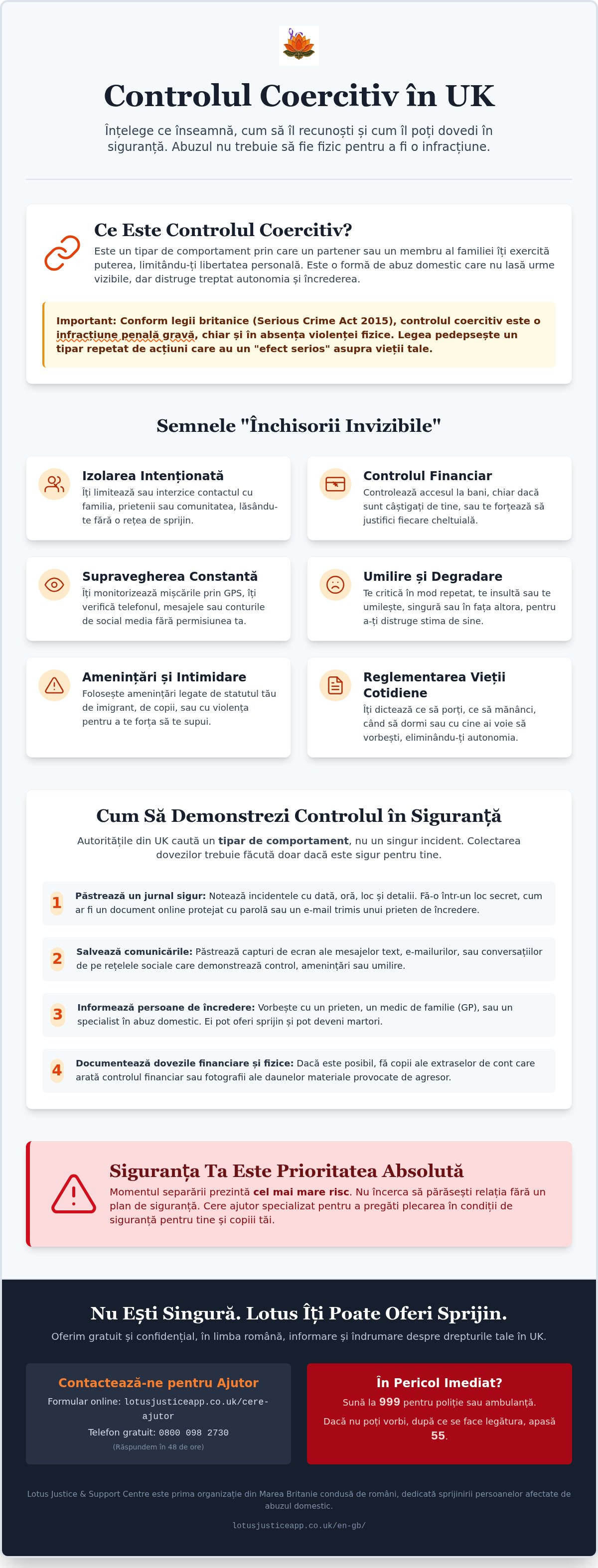
Coercive control is a form of domestic abuse that leaves no visible marks on the body, but gradually destroys a person's autonomy and confidence. Since 2015, it has been considered a serious criminal offence in England and Wales, under Section 76 of the Serious Crime Act. British law defines this behaviour as a repeated pattern of actions by which a partner or family member exercises power over you, limiting your personal freedom. It is vital that you understand what coercive control means and how to prove it in the UK, because the justice system here severely punishes attempts to turn someone's life into a form of psychological captivity.
There is a major difference between an occasional argument, which can occur in any couple, and a systematic pattern of domination. In a healthy relationship, conflicts are resolved through dialogue, and both partners retain the right to make decisions. In cases of coercive control, the abuser uses fear and manipulation to keep you under their permanent control. British law places particular emphasis on psychological impact, recognising that emotional trauma and loss of independence are often more difficult to heal than physical injuries. You can read more about forms of control on our page about what abuse is.
Types of behaviour covered by the law
The abuser uses various tactics to erode your identity and make you dependent. These behaviours include, but are not limited to:
- Monitoring your movements via GPS or constantly demanding photos to prove your whereabouts.
- Strict control over communication, including checking phone messages or social media accounts.
- Restricting access to financial resources, even if you are the one earning the income, or forcing you to justify every pound spent.
- Intentional isolation from family, friends, or the Romanian community in the UK to leave you without an external support system.
The "serious effect" criterion in UK law
For these actions to be criminally punishable, the court must find a "serious effect" on your life. This means that your partner's actions caused you fear of violence on at least two occasions or caused you a state of alarm and distress that radically changed your daily life. Perhaps you quit your job, stopped leaving the house, or changed your circle of friends just to avoid his anger. An essential aspect is that the law punishes the abuser if they knew, or ought to have known, that their actions would have a devastating impact on you. In the UK, your protection begins by recognising this pattern as illegal and unacceptable.
Signs of Coercive Abuse: How to Recognise the "Invisible Prison"?
Coercive abuse does not appear suddenly; it creeps into your life like a net that gradually tightens. It often begins with what appears to be excessive care, but quickly transforms into suffocating surveillance. Your partner begins to take control over your decisions, from the clothes you wear to the people you are allowed to interact with. To understand the depth of this offence, it is essential that you know what coercive control means and how to prove it in the UK, especially since British authorities look for evidence of a pattern of domination, not just isolated incidents.
Humiliation and degradation are daily tools in the hands of the abuser. Perhaps you are constantly criticised for the way you cook, clean, or raise your children. These messages are intended to destroy your self-esteem until you come to believe that you are worth nothing without him. To understand the legal standards by which authorities are guided in these cases, you can consult the official guidance on How to Prove Coercive Control, which details how prosecutors analyse the impact of these behaviours on your life.
Subtle threats are another frequent method of control in our community. The abuser may use your immigration status, threatening to cancel your visa or that you will lose your Pre-Settled or Settled status if you leave him. He may also emotionally blackmail you by telling you that social services will take your children because you do not speak English well. These are lies intended to keep you captive through fear.
Isolation and constant monitoring
Isolation is the main tactic by which you are left without help. Your partner may forbid you from attending English language courses (ESOL) or from getting a job, under the pretext that "your place is at home". In reality, he wants to prevent your financial and social independence. Monitoring can become extreme. He may check your car's mileage daily to see if you have deviated from your route or demand receipts from the shop to justify every pound spent. In some cases, abusers install spyware applications on your phone to read private messages or listen to calls with family in Romania.
Gaslighting: When you start to doubt your own reality
Gaslighting is a form of psychological manipulation so subtle that you start to wonder if you are going mad. When you try to confront your partner about a painful incident, he vehemently denies everything. "It never happened," "You're too sensitive," or "You're imagining things" are standard replies. More seriously, he may turn the blame on you, claiming that his aggressive reactions are caused by your mistakes. This erosion of your reality is directly linked to the signs of psychological abuse in a relationship, which pave the way for total control.
If you recognise these signs in your life, you do not have to go through it alone. It is important to seek a safe space where you can be listened to without being judged. You can always request confidential support to understand your legal options and how you can be protected in the UK.
How to Prove Coercive Control: Safe and Legal Methods in the UK
Unlike physical assaults, where evidence is often visible, in cases of coercive control, the biggest challenge is demonstrating a pattern of behaviour. British law does not look for a single isolated incident, but a series of events which, taken together, show how your personal freedom has been limited. It is essential that you understand what coercive control means and how to prove it in the UK so that you can present the authorities with a clear picture of your reality. Justice in the UK analyses the frequency and intensity of the abuser's actions to determine if they constitute a criminal offence.
Your safety is paramount. Do not try to collect evidence, record conversations, or keep a diary if doing so puts your life in danger or if your partner regularly checks your phone. If you suspect you are being monitored, use a safe device, such as a library computer or a trusted friend's phone. A personal diary can be solid evidence, but only if it is kept in a place where the abuser does not have access, such as a password-protected secure app or a document saved in the cloud on an account unknown to him.
Documentary evidence and official records
Much of the evidence already exists in your digital and financial life. Text messages, emails, or WhatsApp messages in which your partner humiliates you, threatens you, or demands an account for every minute are extremely valuable. Bank statements can demonstrate economic abuse, showing how your funds are restricted or how you are forced to justify minor expenses. Your phone call history is also a silent witness. A long list of missed calls within a short period is clear evidence of harassment and obsessive monitoring.
Third-party statements and institutional reports
You do not have to go through this process alone. Reports from your General Practitioner (GP) are fundamental. If you have consulted the doctor for anxiety, panic attacks, or chronic stress, these medical records can correlate your health condition with the abusive home environment. Statements from friends, colleagues, or even neighbours who have noticed changes in your behaviour or heard repeated arguments can strengthen your case. Furthermore, previous police interventions are officially documented. Even if no arrests were made in the past, the existence of those reports demonstrates a history of conflicts to the authorities. To understand the exact legal framework used by professionals, you can consult this UK Government statutory guidance, which explains how institutions in the UK evaluate these behaviours. Every report from your children's school or from social services adds an important piece to your protection file.
Essential Steps for Your Safety in the UK
Your safety is the number one priority in any strategy for leaving an abusive relationship. After you have gone through the identification stages of what coercive control means and how to prove it in the UK, it is time to look to the future with pragmatism. Do not try to leave suddenly without prior preparation. The experience of specialists shows that the moment of separation is the most dangerous, as the person exercising control feels they are losing total power over you. A safety plan is not just a list of items, but a survival strategy that includes safe places, emergency contacts, and coordinated legal protection.
In the UK, you have powerful tools available to prevent the escalation of violence. Through Clare's Law, you can request information from the police about your partner's past if you fear for your safety. If your situation is assessed as high risk, the case will be managed through MARAC. This is a confidential meeting where experts from various institutions, from the police to social services, collaborate to create a protective shield around you and your children, ensuring you receive the necessary support without having to navigate the system alone.
Police and protection orders
If you are in an emergency situation, call 999 immediately. If the abuser is in the same room and you cannot speak, use the "Silent Solution" system: press 55 after the operator answers the call. The police will understand that you are in danger and will send units to your location. You can also obtain protection through a Domestic Abuse Protection Order (DAPO), an order that specifically covers what coercive control means and how to prove it in the UK. This order can prohibit the abuser from approaching or contacting you, and its violation can lead to a penalty of up to 5 years in prison.
Support for the Romanian community: beyond the language barrier
Many Romanian women fear that they will not be understood by British authorities or that they will be judged. Remember that you have a legal right to a free translator provided by the police, courts, or the National Health Service (NHS). Do not let the English language be an obstacle to your freedom. Furthermore, you can access free legal assistance for Romanians if you are experiencing domestic abuse, which allows you to obtain restraining orders or resolve issues related to child custody. If your residency status depends on your partner, there are special legal provisions that allow you to apply for the right to remain in the UK independently of him, thus protecting your future and safety.
How Lotus Justice & Support Centre Can Help You
Lotus Justice and Support Centre is the first Romanian association in the UK dedicated exclusively to combating domestic abuse. We understand that when you are looking for information about what coercive control means and how to prove it in the UK, you are probably in a state of extreme vulnerability and confusion. Our mission is to be the bridge between you and British institutional systems, offering you a safe space where you can speak in your mother tongue. You are not just a case for us; you are a person who deserves to live without fear, and our team of experts is here to guide you through the labyrinth of local procedures.
One of the most accessible tools we provide is the Lotus AI assistant, available 24/7. It offers you immediate and confidential information about your rights, helping you understand the legal steps without waiting for an appointment. If you feel overwhelmed by interacting with authorities, we offer step-by-step guidance for situations involving the police, NHS, the local council, or social services. We know how intimidating the language barrier can be, so we help you prepare your speech or necessary documents to be believed and protected by the British system.
Free and confidential services
All our services are completely free for the Romanian community. You can call our helpline on 0800 098 2730 to receive immediate assistance and guidance. Once you contact us, we conduct a risk assessment within 48 hours to ensure you receive the right help in a timely manner. On our website, you will also find downloadable bilingual guides, which explain in detail what coercive control means and how to prove it in the UK, offering you clear resources that you can consult at your own pace. Although we do not offer direct legal representation in court, we can direct you to verified organisations that can assist you legally and professionally.
Act now for your peace of mind
The first step towards freedom is recognising that you deserve to be respected. It is not your fault for your partner's abusive behaviour, and you do not have to carry this burden alone. The confidentiality of your data is our absolute priority, strictly adhering to UK GDPR regulations, so you can ask for help without fear that your information will fall into the wrong hands. We are here to offer you emotional support and pragmatic clarity in a moment of crisis, helping you regain control over your own life.
If you need support, you can contact us via the form at lotusjusticeapp.co.uk/request-help or on the freephone number 0800 098 2730. You will receive a response within 48 hours. In case of immediate danger, call 999. If you cannot speak, press 55 after the call is answered.
Regain Your Freedom Step by Step
You have taken a huge step by reading this article. Now you know that the invisible prison in which you feel trapped has a legal name and that British authorities are prepared to intervene. We have analysed together what coercive control means and how to prove it in the UK, emphasising that a pattern of abusive behaviour is sufficient to seek protection, even without physical marks. It is vital to remember that you are not alone in this process and that your safety is the absolute priority.
We are the first Romanian organisation in the UK specifically dedicated to fighting domestic abuse. We offer you a safe space where you can speak in your mother tongue, without judgment. Our team analyses urgent cases within 48 hours, providing you with the necessary clarity to make the best decisions. No matter how complicated your situation seems, there are solutions and specialist support to help you rebuild your life.
You can call our free helpline anytime on 0800 098 2730 for assistance. You deserve a life lived in peace and dignity. If you are in immediate danger, call 999 and press 55 if you cannot speak. We are here to support you on your path to safety.
Frequently Asked Questions about Coercive Control
What is coercive control and how is it defined in UK law?
Coercive control is defined in the UK as a repeated pattern of behaviour by which the abuser uses fear, humiliation, or intimidation to limit your personal freedom. Under Section 76 of the Serious Crime Act 2015, this constitutes a serious criminal offence. The law does not focus on a single isolated incident, but analyses how systematic actions affect your autonomy and daily life, transforming the relationship into a form of psychological captivity.
Can I report coercive control if I have never been physically assaulted?
Yes, you can report abuse even if there has been no physical violence in your relationship. British law recognises that the "invisible prison" created through manipulation and control is just as harmful as physical aggression. It is essential that you understand what coercive control means and how to prove it in the UK, because the police are trained to identify patterns of psychological domination and to offer protection to individuals living under constant emotional terror or forced isolation.
How can I prove emotional abuse if I have no witnesses in the house?
Evidence does not necessarily have to come from eyewitnesses. You can use medical records from your General Practitioner (GP) that attest to your state of anxiety or stress, written messages, emails, or safely kept diaries. Furthermore, statements from friends who have noticed radical changes in your behaviour or reports from your children's school can serve as indirect, yet strong, evidence to demonstrate a pattern of systematic emotional abuse to the authorities.
My partner controls my money and phone. Is this an offence?
Yes, control over finances and phone monitoring are clear forms of economic and coercive abuse, both of which are illegal in the UK. If you are forced to justify every pound spent or if your partner checks your messages without your consent, this constitutes a form of power that violates your fundamental rights. These behaviours are offences because they block your access to resources and independence, keeping you in a state of forced dependency and constant fear.
What evidence does the British police accept for coercive control?
The British police accept a wide range of digital and documentary evidence to support a case. These include screenshots of threatening or humiliating messages, records of obsessive phone calls, bank statements showing financial restrictions, and even social media posts. Official records from your GP, previous police reports (even if they did not result in arrests), and impact statements from the abused person are fundamental for building a strong case.
Can I lose my children if I report coercive control to Social Services?
The role of Social Services is to protect children and support parents who are trying to provide them with a safe environment. Reporting abuse demonstrates that you are a protective parent acting for the safety of your family. Social services collaborate with specialist organisations to offer support, not to punish the person experiencing abuse. In fact, concealing abuse can be considered a safeguarding concern, whilst seeking help is seen as a responsible and necessary action.
Where can I find help in Romanian if I am being controlled by my partner in the UK?
You can find specialist and confidential support at Lotus Justice & Support Centre, the first Romanian association in the UK dedicated to combating domestic abuse. We offer a free helpline on 0800 098 2730 and assistance through the lotusjusticeapp. Our team offers step-by-step guidance in Romanian for interacting with the police or social services. We conduct a triage for urgent cases within 48 hours, ensuring you receive correct information about your rights in the UK.
What is Clare's Law and how can it help me find out the truth about my partner?
Clare's Law (Domestic Violence Disclosure Scheme) gives you the legal right to ask the police for information about the violent past of a partner or ex-partner. You can submit a request under the "Right to Ask" if you suspect that the person close to you has a history of domestic abuse. The police can disclose this information if there is a real risk to your safety, allowing you to make informed decisions and access specialist support before the situation becomes dangerous.

Disclaimer
The information on this blog is general and educational. It does not constitute individual legal, medical or psychological advice and is not a substitute for support from a professional who knows your circumstances.
If you are in immediate danger, call 999. If you cannot speak, press 55 once connected.
For free, confidential support in Romanian, use the form at lotusjusticeapp.co.uk/cere-ajutor or call 0800 098 2730. We respond within 48 hours.
Online safety: if you are using a device the abuser can access, clear your browsing history or use a private window. You can also access this site from a public library, from work or from a trusted person's phone.
Lotus Justice & Support Centre CIC, company registered in England and Wales no. 17184809. ICO registration ZC144429.

