

A CPD certificate confirms that a course has been evaluated, but does it tell you whether the training suits your role? When comparing options for CPD certification in domestic abuse prevention, it is natural to want to know what the document certifies and whether you will be able to respond safely when someone discloses an abusive situation to you.
Accreditation can be a helpful guide, but it does not turn training into a professional qualification, nor does it guarantee that you will know how to manage every situation. What matters is what the course covers, who it is aimed at, and whether it aligns with your responsibilities. It is just as important to recognise the boundaries of your role and know when to signpost someone to a specialist service.
In this article, you will find clear criteria for assessing a CPD course, including the Lotus online course on understanding domestic violence. You will learn what to check in the syllabus, how to relate learning to your role, and what sensible steps you can take if someone discloses abuse. Do not assume that a certificate provides outcomes or remits that it does not promise.
Key Takeaways
- Understand what a CPD certificate can confirm and why it should not be confused with a professional qualification or a guarantee of competence.
- Evaluate the syllabus, format, and target audience to see whether a domestic abuse prevention CPD certification course suits your role.
- Check whether the course topics help you understand forms of abuse and identify when specialist signposting is needed.
- If someone discloses an abusive situation, listen, check whether there is immediate danger, and follow your organisation's procedures without exceeding the boundaries of your role.
- Assess the Lotus CPD-certified online course on understanding domestic violence using the same criteria, without assuming unconfirmed outcomes or content.
What does CPD certification mean in a course on domestic abuse prevention?
CPD is the abbreviation used in the United Kingdom for Continuing Professional Development. It means updating and expanding your knowledge through learning activities related to your role. A CPD course can be one such activity, but the label alone does not show how in-depth the course is or whether it matches your responsibilities.
When exploring CPD certification in domestic abuse prevention, check both what the certificate certifies and what topics are addressed in the course. For a broad overview, you can also consult this overview of domestic violence. That resource provides context, but it does not confirm the content or standing of any particular course.
What can a CPD certificate confirm?
A certificate can confirm participation in or completion of a learning activity, although the precise wording depends on the document and the provider's information. Before you enrol, check what document you will receive, who issues it, and what it states about the course. Do not assume that the certificate is automatically accepted by every employer or professional body.
Lotus Justice & Support Centre offers a CPD-certified online course on understanding domestic violence. The available information confirms that the course exists, but does not specify the exact wording of the certificate or which professional requirements it satisfies. Ask for current details about the document and check directly with your employer whether it is relevant to your role.
Taking part in a CPD-certified course can confirm learning, but it does not equal a professional qualification and does not, in itself, confer a licence or right to practice.
What CPD training does not replace
A course does not replace the formal qualifications required for your profession, ongoing supervision, or the internal procedures of the organisation where you work. Learning about the different forms of abuse can help you better understand a disclosure and identify when specialist support is needed. However, this does not equate to a formal risk assessment.
Training can support your professional judgement, but it does not guarantee a specific outcome for the person you are supporting. If a situation is unclear, follow your organisation's procedures and seek guidance from your supervisor or a specialist service. Understanding the limits of the course and of your role is part of using information responsibly.
What should a CPD course on domestic abuse prevention teach?
Evaluate a syllabus by what it helps you understand and do within the boundaries of your role, rather than by a list of topics that sound convincing. Check whether the provider explains the forms of domestic abuse and how they can occur together or repeat over time. Abuse is not always visible: control, intimidation, and financial abuse can undermine a person's autonomy without leaving physical marks.
As benchmarks, look in the course description for explanations of physical, emotional, psychological, and financial abuse, as well as coercive or controlling behaviour. Check whether the training discusses the impact on the individual and any children, how to respond to a disclosure, safety considerations, and signposting to specialist services. These are evaluation criteria, not guaranteed modules in every course offering CPD certification in domestic abuse prevention.
To evaluate the relevance of training in the United Kingdom, compare the published syllabus with the activities you actually carry out and your organisation's procedures. Check whether the provider explains the limitations of the course and whether the materials guide you to follow internal steps when a safety concern arises. A general overview of the subject is no substitute for practical guidance on these aspects.
Useful knowledge for social workers and volunteers
Needs differ depending on responsibilities. A professional may have statutory duties defined by their role and organisational procedures, whilst a volunteer's role may be limited to listening and signposting. Do not assume that participating in the same course grants the same responsibilities to everyone.
Check whether the syllabus explains the limits of confidentiality, how safety must be considered, and who to pass a concern to according to internal policies. Look for clear distinctions between recognising possible patterns, conducting formal risk assessments, and escalating a concern. These are distinct activities.
How to handle a disclosure safely
Useful training should help you listen calmly, without judging, without pressuring the person for details, and without attributing blame. Do not promise an outcome that you cannot control. Follow your organisation's safeguarding procedures and seek guidance from a supervisor or a specialist service. Do not investigate the situation and do not confront the person alleged to be carrying out the abuse.
The role of training is to help you listen carefully, recognise your limits, and signpost prudently to specialist support, not to replace expert intervention. If the situation affects you directly and you need support in Romanian, you can request help from Lotus.
How do you compare CPD certified courses for your role?
Start with the activities you actually carry out. If you speak with individuals seeking support, check whether the syllabus helps you understand domestic abuse and signpost with care. If your role does not include risk assessment, look for explicit boundaries showing that the training does not confer this responsibility upon you.
Use the criteria below to compare courses offering CPD certification in domestic abuse prevention. Fill in the table based on official information and request clarification from the provider if any details are missing.
| Criterion | What to check | Fit for your role |
|---|---|---|
| Certification | Who issues the certificate and what exactly does the provider state that it certifies? | Confirm with your employer whether the document is relevant to the requirements of the role. |
| Syllabus | What topics are covered and how are the limitations of the training explained? | Compare the topics with situations you encounter, without assuming that you will receive new duties. |
| Format and access | How is the course delivered, what access conditions apply, and what does completion involve? | Choose a format that you can complete on your own terms. |
| Audience and support | Who is the course intended for, and what guidance or resources are described? | Check whether the level and support match your experience and responsibilities. |
| Duration and cost | What are the duration, cost, and current access terms? | Request details directly from the provider before making a decision. |
Criteria to check before choosing
Do not rely solely on the words "CPD certified". Read the official course page and verify who issues the certificate, what wording it uses, and what you need to do to receive it. Then compare the published syllabus with your responsibilities. A broad description does not guarantee that a course covers every situation you might encounter.
Questions for your employer or organisation
Ask whether the training aligns with internal policies and your professional goals. Clarify whether your role requires additional training or supervision. Acceptance of a certificate is not automatic for every post, so checking directly helps you make an informed choice. Before enrolling, confirm the current duration, cost, and access terms with the provider.
How do you apply learning without exceeding the boundaries of your role?
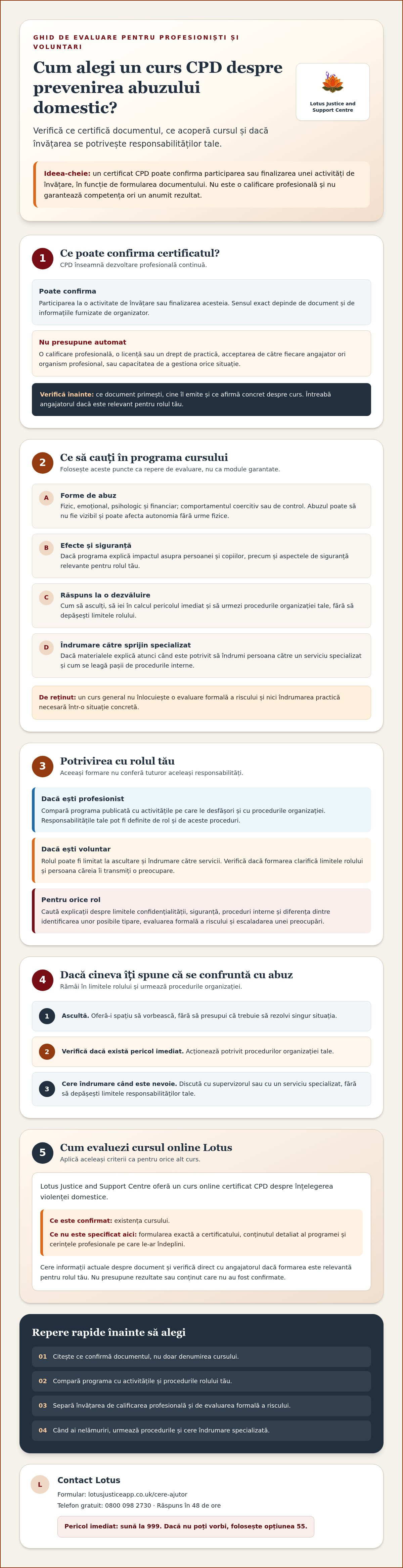
A course offering CPD certification in domestic abuse prevention can provide helpful reference points, but it does not mean you have to resolve the situation alone, and it does not replace your organisation's procedures, supervision, or specialist support. When someone discloses abuse to you, start with simple steps: listen, check whether there is immediate danger, and follow the procedure appropriate to your role.
If you need to clarify which behaviours can form part of domestic abuse, consult the guide on what domestic abuse is. General information can support understanding, but it does not replace specialist assessment or guidance.
Steps following a disclosure
Stay calm and allow the person to speak at their own pace. Listen without blaming them or pressing for details. You can gently ask whether they feel in danger right now and whether it is safe for them to speak at that moment.
Do not promise absolute confidentiality. Explain, as far as possible, that you will need to follow your organisation's procedures if a safety concern arises. Do not attempt to investigate, confront the person alleged to have caused harm, or gather information beyond what is necessary for your role. Record or pass on information strictly in accordance with internal procedures.
Then follow the safeguarding steps established by your organisation. If you are unsure what to do, seek guidance from your supervisor or a specialist service, without taking on duties outside your remit.
When should specialist support be involved?
Involve specialist support whenever organisational procedures direct you to do so, or when the concern goes beyond your role and training. Training can support your judgement, but it does not replace supervision, assessments conducted by competent professionals, or direct help from specialist services.
If there is immediate danger, call 999 for police, ambulance, or fire services. If the person cannot speak, they can use the 55 Silent Solution during a mobile call. A training course is not an emergency service and must never be used in place of urgent intervention.
Request help from Lotus Justice and Support Centre
The Lotus Justice CPD course: evaluating suitability and next steps
Lotus Justice & Support Centre offers a CPD-certified online course on understanding domestic violence. It can be a training option for professionals and volunteers seeking to develop their understanding of the subject. The offer confirms the general theme and online format, but it is not sufficient on its own to infer the full syllabus, duration, cost, access conditions, or the exact outcomes you will achieve.
Before choosing the course, apply the same criteria you would use for any CPD training: check the current information published by the provider, what the certificate confirms, what topics are presented, and whether these match your activities. If you require a CPD certification in domestic abuse prevention for a specific role, confirm beforehand with your employer whether the training meets their expectations.
Who might the course be relevant for?
The course may be relevant if you work or volunteer in the community and wish to deepen your understanding of domestic violence. Suitability depends not only on the subject matter, but also on your specific responsibilities. Do not assume that introductory training replaces the qualifications, supervision, or procedures specific to a post.
For full details, check the current course page and ask the provider what document you will receive, how the training is delivered, what is required for completion, and what the access conditions are. You can also consult the material on the online course for understanding domestic violence, then compare that information with your needs and your organisation's requirements. Do not assume that the certificate will be automatically accepted by your employer.
How to seek guidance safely
If your inquiry concerns your own situation or you need support, you can contact Lotus through the help form or on freephone 0800 098 2730. Cases considered urgent are prioritised for a response within 48 hours. If your device could be monitored, choose a contact method that you feel is safe.
In immediate danger, call 999 for police, ambulance, or fire services. If you cannot speak during a mobile call, use the 55 Silent Solution option.
Choose training carefully and continue learning
A CPD-certified course can support your ongoing development, but a certificate is not a professional qualification and does not guarantee that you will be able to manage every situation. When assessing an option for CPD certification in domestic abuse prevention, check what the document certifies, what information is published about the syllabus, and whether the training aligns with your responsibilities. Confirm role requirements with your employer and follow your organisation's procedures whenever someone discloses abuse.
Lotus Justice & Support Centre CIC provides a CPD-certified online course on understanding domestic violence and supports the Romanian community across the United Kingdom. Check current course details before enrolling. If you or someone you know needs support, you can contact Lotus via the form or on freephone 0800 098 2730. Cases considered urgent are prioritised for a response within 48 hours. For immediate danger, call 999; if you cannot speak during a mobile call, use the 55 option.
With verified information, clear boundaries, and appropriate guidance, you can contribute to a more attentive and safer response.
Frequently asked questions
Is a CPD domestic abuse course mandatory for social workers?
There is no single answer that applies to every social worker. Requirements depend on your specific role, your employer, and organisational procedures. Ask your manager or training lead what learning is required for your duties and whether a particular course is appropriate. This article provides general information, not individual legal or professional advice. For specific guidance, follow your organisation's procedures.
Can volunteers take a CPD course on domestic abuse prevention?
Yes, a volunteer can consider such training if it is relevant to their role and organisational requirements. A course can help build understanding of the subject, but it does not automatically expand a volunteer's remit, nor does it authorise them to assess risk or provide specialist services. Before supporting someone, check internal procedures, the limits of your role, and to whom you should escalate a concern.
How do I check whether a CPD course is suitable for my work?
Compare the published syllabus, the intended audience, the format, and the document awarded upon completion. Check information directly with the provider and request clarification if it is unclear what the certificate certifies or what completion involves. Then compare the content with situations you encounter in your role and confirm its relevance with your employer. Do not assume that a certificate is accepted automatically or that any course meets your organisation's requirements.
Does a CPD certificate allow me to offer legal advice or representation?
Do not assume that a CPD certificate gives you the right to offer legal advice or legal representation. A course on domestic abuse must not be confused with a legal qualification, and this guidance does not determine what rights of practice apply to your role. Confirm requirements with your employer and seek appropriate guidance. Lotus provides legal information and guidance, but does not provide direct legal representation in court.
What should I do if someone discloses that they are experiencing domestic abuse?
Listen without judging or pressing the person for details, then follow your organisation's safeguarding procedures and seek specialist guidance. Do not confront the person alleged to have committed the abuse, and do not investigate the situation. For support, you can submit the Lotus help form or call freephone 0800 098 2730. In immediate danger, call 999; if you cannot speak from a mobile, use the 55 Silent Solution option.

Disclaimer
The information on this blog is general and educational in nature. It does not constitute individual legal, medical, or psychological advice and is not a substitute for support from a specialist who knows your circumstances.
If you are in immediate danger, call 999. If you cannot speak, press 55 once connected.
For free, confidential support in Romanian, complete the form at lotusjusticeapp.co.uk/cere-ajutor or call 0800 098 2730. We respond within 48 hours.
Online safety: if you are using a device that the abuser can access, clear your browsing history or use a private window. You can also access this site from a public library, from work, or from the phone of a trusted person.
Lotus Justice & Support Centre CIC, company registered in England and Wales no. 17184809. ICO registration ZC144429.

