

Accurate information can transform confusion into a first step towards safety. For abuse survivors in the UK, the English language, unfamiliar statutory procedures, and the lack of a personal support network can make seeking help feel overwhelming. That is why education and informative guidance for abuse survivors means more than simple explanations: it means understanding what is happening to you and knowing what options you have.
You may be wondering whether what you are experiencing qualifies as abuse, or whether you can ask for help without having a deep knowledge of the British system. You do not need to have all the answers before reaching out for support. Abuse can be physical, but it can also be emotional, coercive, or financial. Understanding these different forms can help you recognise your experience without blaming yourself.
In this 2026 guide, you will learn about the role of education, support services, and legal guidance, as well as how to prepare for a conversation with an institution or a solicitor. You will also see how bilingual resources can help you ask the right questions and make informed decisions, step by step.
Key Takeaways
- Learn to recognise the signs of coercive control and use verified information to make decisions at your own pace.
- Find out how support from an organisation that understands the Romanian community can help you communicate with UK statutory services.
- Discover how education and informative guidance for abuse survivors can help you prepare for legal appointments, and why guidance differs from court representation.
- Understand what details you can request through Clare's Law and what to consider when drafting a personal safety plan.
- Explore bilingual resources and support from Lotus Justice & Support Centre to understand your options and find out how to request guidance.
The power of information: why education is a first step towards safety
When legal terms, official rules, and statutory agencies are unfamiliar, it is easy to feel that you have no options. Reliable information helps you understand which behaviours are abusive, what questions you can ask, and which choices belong entirely to you. You do not have to make all decisions at once. You can start simply by clarifying what is happening and finding out what support exists.
Education does not replace specialist support, nor does it force you into taking any specific step. It provides a clear foundation for conversations with a support service, the police, or a solicitor. For a broader overview of the British context, you can read information on domestic abuse in the United Kingdom. For explanations in Romanian, you can also see types and signs of abuse.
Recognising abuse beyond physical violence
Abuse does not always leave physical marks. The Domestic Abuse Act 2021 recognises coercive or controlling behaviour across England and Wales, as well as emotional and economic abuse. Coercive control can involve persistent monitoring, isolation from family and friends, or intimidation through threats. Economic abuse can include restricting access to money, preventing you from working, or controlling your daily expenditure, thereby limiting your independence.
If you recognise your own experience in these descriptions, what you are going through deserves to be taken seriously. Information alone does not establish a formal legal conclusion, but it helps you name these behaviours and discuss them with a support worker. It is never your fault that someone else attempts to control your life and choices.
The role of awareness training
The Lotus Justice online course, "Understanding Domestic Abuse", is CPD-certified and provides a structured learning environment to explore this issue. The material can help you understand power dynamics and recognise patterns that may be difficult to see when you are inside the relationship. This training is also relevant for professionals who work with survivors, giving them practical insights to identify abuse and respond with greater empathy.
Education and informative guidance for abuse survivors can turn overwhelming questions into manageable steps: write down what worries you, ask for explanations in a language you fully understand, and explore your choices at your own pace. Learning does not erase what happened, nor does it guarantee that abuse will stop, but it helps you assess risks and make safer, more informed choices.
Navigating the UK system: bilingual resources and By and For support
When you have to explain a painful situation in a language that is not your mother tongue, a misunderstood word can heighten anxiety. Romanian-English bilingual resources allow you to check the precise meaning of information and prepare clear questions for public authorities. By and For support, provided by people who share your cultural and linguistic background, creates a familiar setting and helps alleviate feelings of isolation. It does not replace public statutory services, but it prepares you to access them with confidence.
Tailored support for the Romanian community
For Romanians living in the United Kingdom, common obstacles include unfamiliarity with administrative procedures, fear of being misunderstood, and the absence of a close family support network. Lotus Justice & Support Centre is a non-profit organisation dedicated to the Romanian community, providing free support and legal guidance for those affected by domestic abuse. You can also use the organisation's digital AI assistant to find information and guidance. This tool does not replace professional assessment or emergency services.
You do not need to prove or justify your experience simply to ask for information. You can begin with a simple question and share only as much as you feel comfortable disclosing. Bilingual guides and materials help you understand terms and steps before attending an official appointment.
Practical steps when language is a barrier
At any appointment or meeting with an institution, make it clear straight away that you require language support to follow the conversation. You can ask: "Can I speak with a Romanian interpreter?" and "Could I please have these explanations in writing?". Ask what interpretation facilities are provided and how they are arranged. If you do not understand a term, ask for it to be repeated or explained in simpler words. Never rely on the partner whose behaviour causes you concern to translate sensitive matters for you.
Children's services and social care procedures in the UK may differ significantly from what you know. If a social worker contacts you, you can ask them to explain the reason for the meeting, what the next steps are, and whether you can receive the information in Romanian. Write down the professional's name, their local authority or organisation, and your questions. For official statutory guidance, consult government resources for domestic abuse support, including translations where available.
Official letter templates, where accessible, can assist you in requesting information or records in writing. Read them thoroughly and adapt them to your personal circumstances. If you are unsure what an official reply means, ask for clarification before taking further action. Education and informative guidance for abuse survivors is about knowing what to ask, rather than trying to handle the entire system on your own. If you need help understanding your options, you can get in touch with Lotus Justice & Support Centre.
Informative guidance and legal assistance: what free support can include
When dealing with questions about divorce, child arrangements, or immigration status, knowing who to turn to can be difficult. A specialist support centre can explain your general choices and help you prepare for what comes next. However, informative legal guidance is distinct from direct representation in court.
Lotus Justice & Support Centre provides free information and legal guidance, but does not represent individuals in court proceedings. Guidance can help you understand what questions to ask, what paperwork to organise, and when it is necessary to instruct a solicitor. Information regarding your rights serves as an educational starting point, not as a replacement for tailored legal advice.
What informative guidance covers
You can receive general explanations of legal concepts and administrative stages, such as what details to clarify before speaking with a family solicitor about divorce or child arrangements. Depending on your situation, you can get help structuring your questions and identifying which options need checking. Informative support never assumes you must make an immediate decision.
- Write down a timeline of what happened and what outcome you are hoping to achieve.
- Gather relevant documents that you already have, without putting yourself in danger to obtain them.
- Ask which matters fall under general guidance and which strictly require a solicitor's legal advice.
When to seek specialist legal advice
If you need to submit formal court applications, respond to legal proceedings, or make decisions with substantial legal consequences, you should consult a qualified solicitor. Ask if they have specialist experience in your issue and whether they can assess your eligibility for Legal Aid, the public legal assistance scheme. Non-profit organisations can offer valuable information and advocacy, but their remits differ. Always verify whether an organisation provides general guidance, legal advice, or court representation.
In England and Wales, Legal Aid may be accessible for certain family law matters involving domestic abuse. Eligibility depends on an assessment of your financial circumstances and the merits of your case, and you will usually be required to provide evidence of abuse. Evidence can include letters from a doctor, a specialist domestic abuse service, or the police. Ask a solicitor or an independent advice service to check the rules that apply to your case.
Education and informative guidance for abuse survivors ensures you enter legal appointments better prepared, with your questions written down, relevant records organised, and a clear understanding of the support you require. You do not have to work through every single step alone.
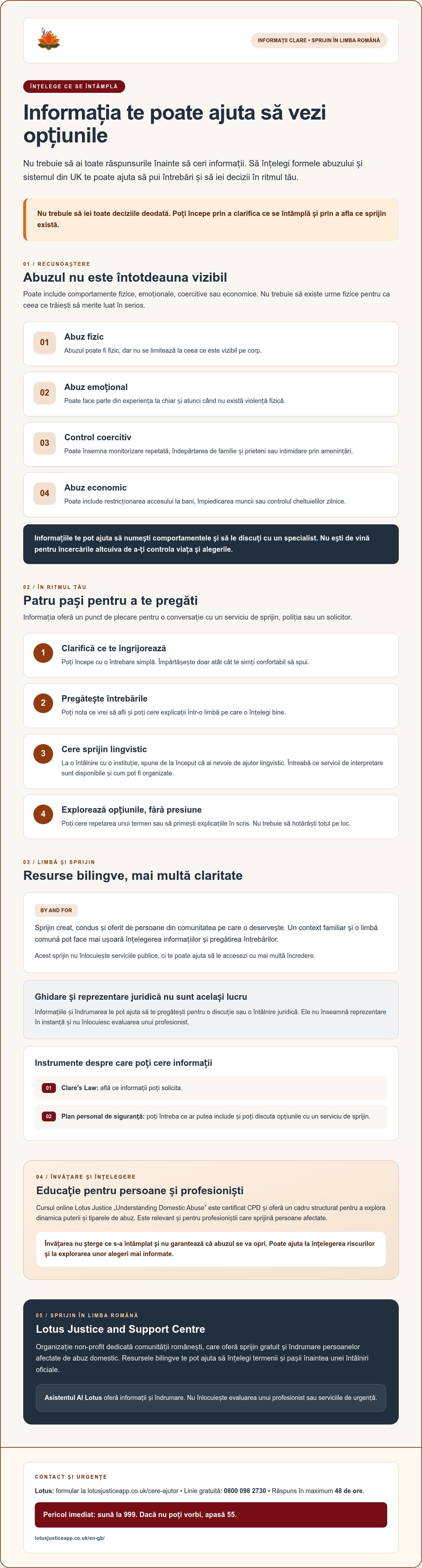
Practical tools for your protection: from Clare's Law to safety plans
Background information, multi-agency support, and a tailored safety plan can help clarify your options. These tools serve different functions: Clare's Law allows you to request information from the police, whereas a safety plan helps you manage potential danger. Neither tool replaces emergency assistance when risk is immediate.
Clare's Law: the right to ask
In England and Wales, the Domestic Violence Disclosure Scheme, commonly known as Clare's Law, allows you to ask the police for information about a partner's violent or abusive history. You can submit an enquiry online via the police website, by calling 101, or by visiting a police station in person. A close friend, family member, or professional can also make an application if they are concerned for your safety. The police will review the application and determine whether disclosing information is lawful and necessary to protect you. Ask the police how the enquiry and your confidentiality will be managed.
Clare's Law is an informative disclosure tool, not a protective court order, and it does not automatically provide a complete risk assessment. If you receive a disclosure and feel uncertain about the implications, ask the police or a specialist organisation for clarification. You can also explore information about Clare's Law.
A personalised safety plan
A safety plan outlines trusted contacts, a place you could go in an emergency, and safe ways to call for help. If it is safe to do so, keep essential documents, necessary medications, spare keys, and important items in an accessible place. Do not keep emergency bags or written plans where the person who is abusing you might discover them. Leaving a relationship carries the highest level of risk, which is why planning should be discussed with a specialist domestic abuse worker whenever possible.
A MARAC (Multi-Agency Risk Assessment Conference) is a confidential meeting where statutory and voluntary organisations share information about high-risk domestic abuse cases to coordinate protective measures. You do not refer yourself to a MARAC directly; a professional, such as an Independent Domestic Violence Advisor (IDVA) or the police, will explain if your case meets the threshold for referral. Across England and Wales, thousands of high-risk cases are reviewed annually by these multi-agency panels to increase safety.
You can access resources and informative materials via the Lotus app, but remember that the app does not automatically transmit reports to the police or monitor risk levels. Pay attention to device safety and use secure channels of communication. Education and informative guidance for abuse survivors helps you consider your options without feeling pressured into making sudden decisions.
If you are in immediate danger, call 999. If calling from a mobile and unable to speak, listen to the operator and press 55 when prompted. For non-urgent guidance, you can contact Lotus Justice & Support Centre on 0800 098 2730.
How Lotus Justice & Support Centre supports you
Reaching out for help can feel like an intimidating step, especially if you are unsure what details you will be asked or what happens after first contact. Lotus Justice & Support Centre is a non-profit organisation dedicated to the Romanian community in the UK, providing free support and legal guidance for those affected by domestic abuse. You can telephone 0800 098 2730 or visit lotusjusticeapp.co.uk to complete the support request form.
First contact and what you can ask
Share only what you feel safe and comfortable disclosing. You can ask what information is required, how your details are protected, and what kind of guidance the organisation can provide. If you have concerns about confidentiality, you can ask how your personal data is handled under applicable legislation, including the UK GDPR.
Urgent enquiries are prioritised to receive a response within 48 hours. Ask what steps follow and how you can re-contact the service if your circumstances change. Lotus also provides a 24/7 digital AI assistant for general information; this does not replace bespoke support or emergency intervention.
Bilingual resources and support at your own pace
Bilingual guides and downloadable materials enable you to understand key concepts and processes without relying solely on English explanations. You can use these materials to structure your questions before speaking with a statutory service or a legal professional. Education and informative guidance for abuse survivors means having clear information so you can decide what step is right for you, without any pressure to share everything at once.
Lotus provides guidance and informative resources. Ask directly what support is available for your circumstances and what the boundaries of the service are. You are under no obligation to use your personal experience to help others; your safety and wellbeing remain the single priority.
Contact Lotus Justice & Support Centre on 0800 098 2730 or use the form at lotusjusticeapp.co.uk to request guidance. If you are in immediate danger, dial 999. If calling from a mobile phone and you cannot speak, follow the operator's instructions and press 55 when prompted.
Take the next step towards greater safety
Information helps you identify abusive behaviours, understand your available choices, and communicate clearly with public bodies or legal professionals. Bilingual materials and specialist guidance make the UK system far more approachable, without requiring you to make hasty decisions. Education and informative guidance for abuse survivors provides you with reference points and reassurance as you choose what is best for your future.
Lotus Justice & Support Centre offers free support and legal guidance to the Romanian community in the UK. If you would like to know what guidance suits your situation, submit an enquiry.
For support, call Lotus Justice & Support Centre on 0800 098 2730. If you are in immediate danger, dial 999. If calling from a mobile and unable to speak, listen to the instructions and press 55 when prompted. You can seek support at your own pace.
Frequently asked questions
What is informative guidance and how can it help if I am in an abusive relationship?
Informative guidance provides objective explanations about abuse dynamics and available support options without making decisions for you. It helps you identify controlling behaviours, prepare questions for a solicitor or local authority, and understand what steps are available. Education and informative guidance for abuse survivors helps you make informed choices at your own pace.
Is the service provided by Lotus Justice free and confidential?
Yes. Lotus Justice & Support Centre provides free support, legal guidance, and informational resources, and all services are confidential. Personal data is handled in accordance with the UK GDPR and data protection standards. If you have questions about data storage or the limits of confidentiality, you can ask before sharing sensitive details. The telephone helpline is 0800 098 2730.
Can I receive assistance in Romanian if I do not speak fluent English?
Yes. Lotus Justice is dedicated to the Romanian community in the UK and offers bilingual materials, downloadable guides, and a digital AI assistant in Romanian. You can receive explanations in your own language and ask about interpretation options when dealing with statutory agencies. When attending meetings with the police or NHS staff, you can request an official interpreter.
What should I do if I suspect my partner is monitoring my phone?
If you suspect your device is monitored, use a safe computer or phone whenever possible, such as one belonging to a trusted friend or at a local library. Avoid making sudden alterations to passwords or settings if doing so might alert your partner and increase danger. Avoid storing safety plans or sensitive messages on an accessible device. If you are in immediate danger, do not wait; call 999 as soon as it is safe to do so.
How can I find out if my partner has a violent history under Clare's Law?
In England and Wales, you can request information from the police under the Domestic Violence Disclosure Scheme, known as Clare's Law. You can submit an enquiry via the police website, by calling 101, or at a local police station. A concerned third party can also apply on your behalf. The police will review the case and decide whether disclosing information is necessary to safeguard you. You can ask the police how confidentiality is managed throughout the process.
Where can I turn if I need legal representation in court?
You should contact a qualified solicitor who specialises in family law or your specific area of concern. Ask whether they provide court representation and whether they can assess your eligibility for Legal Aid. In England and Wales, Legal Aid may cover certain family cases involving domestic abuse, subject to financial means, case merits, and prescribed evidence. Lotus Justice provides guidance and information, but does not provide direct court representation.
What should I do if I am in immediate danger and cannot speak on the phone?
Call 999. If you are calling from a mobile phone and cannot speak safely, listen to the call handler and press 55 when prompted (the Silent Solution system). This informs the operator that you need police assistance without you having to speak. If it is safe, move to a public place with other people and seek assistance. Do not contact an advice organisation first if you are facing immediate harm.
Does Lotus Justice provide emergency refuge accommodation for mothers and children?
No. Lotus Justice does not operate its own emergency refuge or provide direct accommodation. The organisation provides information, guidance, and emotional support, while refuge accommodation is managed by local councils and specialist housing providers. You can contact your local council housing team or a domestic abuse helpline to discuss emergency accommodation options. If you or your children are in immediate danger, call 999.

Disclaimer
The information on this blog is of a general and educational nature. It does not constitute individual legal, medical, or psychological advice and is not a substitute for support from a specialist who understands your circumstances.
If you are in immediate danger, call 999. If you cannot speak, press 55 once connected.
For free, confidential support in Romanian, complete the form at lotusjusticeapp.co.uk/cere-ajutor or call 0800 098 2730. We respond within 48 hours.
Online safety: if you are using a device that the abuser can access, clear your browsing history or use a private window. You can also access this website from a public library, from work, or from a trusted person's phone.
Lotus Justice & Support Centre CIC, registered company in England and Wales no. 17184809. ICO registration ZC144429.

