

What transforms a simple intention to help into an intervention that genuinely protects? When supporting someone affected by abusive behaviour in the United Kingdom, a lack of adequate preparation can introduce unforeseen risks. This is why professional domestic abuse prevention training forms the vital bridge between a natural instinct for solidarity and strict adherence to safety procedures.
We understand how overwhelming it can feel to navigate the terminology of the British statutory system or to locate training courses that are genuinely relevant and professionally recognised. You need clarity, alongside the certainty that every step you take remains confidential and upholds the dignity of those around you. This comprehensive guide helps you select training tailored to current requirements, highlighting the standards a qualification must meet and why By and For cultural expertise is essential. You will discover the criteria for validating a CPD-certified course, the dynamics of hidden forms of coercive control, and the correct multi-agency collaboration procedures.
Key Takeaways
- Choosing professional domestic abuse prevention training provides you with complete clarity in recognising subtle signs of coercive control and economic abuse under the UK statutory framework.
- You learn how to assess immediate danger and implement multi-agency collaboration procedures, always safeguarding the safety and confidentiality of the person you support.
- You will understand the essential criteria for selecting a CPD-accredited programme and why a By and For approach removes linguistic and cultural barriers within the community.
- You acquire the skills to open a safe dialogue without moral judgement, facilitating access to authorised support and protection services.
- You discover how completing the CPD-certified online course "Understanding Domestic Abuse", developed by Lotus Justice, provides official recognition and applied skills for community support.
What does professional domestic abuse prevention training involve?
A robust training programme goes well beyond general theoretical concepts. In the United Kingdom, professional domestic abuse prevention training teaches you how to identify harmful behaviours before they escalate into severe physical assaults. Unlike courses focused solely on Eastern European legislation or the domestic violence situation in Romania, a module tailored to the diaspora community focuses on the UK framework defined by the Domestic Abuse Act 2021.
Practical training delivers clear tools to intervene without escalating risk. You learn safe communication techniques, practice active listening, and understand the importance of non-judgemental responses whenever someone chooses to share what is taking place at home.
Defining abuse beyond visible physical harm
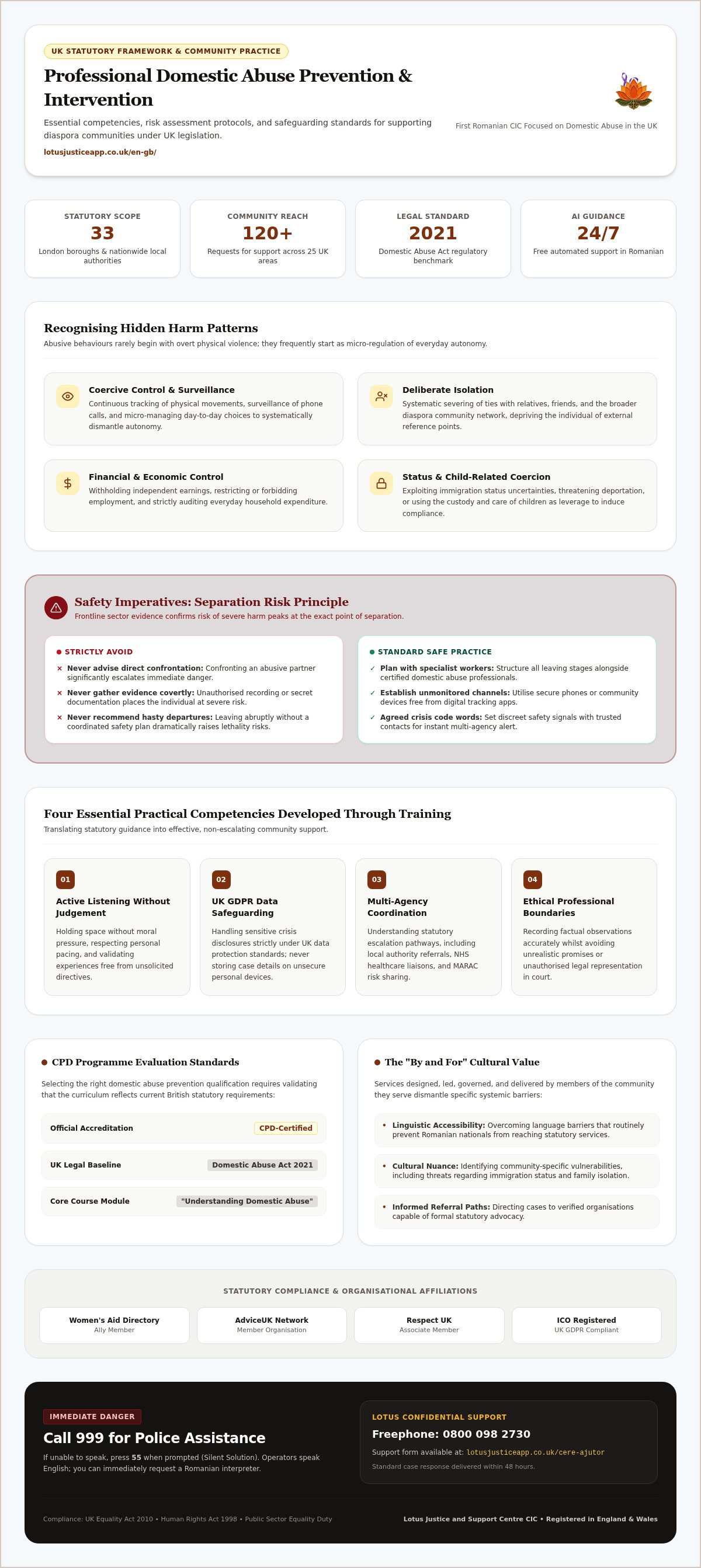
Abusive behaviours rarely begin with overt acts of violence. More often than not, patterns start with micro-regulation of everyday life. To identify these situations accurately, you can consult further details on what abuse is and how it manifests within family life.
Adequate preparation helps you recognise the signs of:
- Coercive control, continuous monitoring of movements, or surveillance of telephone calls;
- Deliberate isolation from friends, relatives, or the local Romanian community network;
- Financial abuse, manifested by withholding independent income, forbidding employment, or strictly policing daily expenditure;
- Emotional blackmail linked to immigration status or the care of children.
All of these actions gradually erode personal autonomy. Over time, fear and induced dependency prevent the person affected from reaching out to local services for help.
Professional safeguarding standards and data protection
Safe intervention relies directly on adhering to ethical and legal standards. When undertaking professional domestic abuse prevention training, assimilating safeguarding procedures is essential. The course demonstrates how to handle sensitive information in accordance with UK GDPR standards, avoiding the storage of details on unsecure devices.
Understanding professional boundaries enables you to protect the safety of those involved without making unrealistic promises. You will learn to document factual details accurately and direct cases towards specialised local services, whilst maintaining strict confidentiality at all times.
Essential practical skills developed through training courses
Acquiring concrete skills makes the difference between a hesitant response and a life-saving intervention. Professional domestic abuse prevention training equips you to evaluate danger levels swiftly without relying on assumptions. Beyond good intentions, supporting someone requires active listening free from judgement or moral pressure, respecting the personal pace of someone experiencing this trauma.
To distinguish subtle manipulation from everyday relationship arguments, it is helpful to explore these signs of psychological abuse in a relationship. In the UK, language barriers frequently hinder the Romanian community from accessing statutory support. Whilst official initiatives such as those described by the institutional prevention framework in Romania set national guidelines, living in another country demands proficiency in local British protocols.
Risk assessment and safety planning
Rigorous planning is crucial. Sector evidence and frontline practice show that the risk of harm reaches its absolute peak at the point of separation. For this reason, professional training teaches you never to recommend hasty departures or covert evidence gathering on one's own.
An in-depth course guides you in structuring safe measures:
- Identifying secure communication channels using unmonitored devices;
- Preparing essential steps alongside a specialist domestic abuse worker;
- Establishing safe code words for extreme emergencies;
- Signposting to trained professionals whenever it is necessary to request confidential support for comprehensive safety planning.
Early intervention within multi-agency conferences
Managing severe crises effectively requires an interconnected support network. By attending professional domestic abuse prevention training, you understand the mechanism behind MARAC meetings, where police, social care, and support agencies share information confidentially regarding high-risk cases.
You learn early referral pathways when children are involved, alongside the application of modern British protective measures, such as the pilot Domestic Abuse Protection Order (DAPO). These contemporary measures impose flexible restrictions on perpetrators alongside positive behaviour-change requirements, fostering a safer environment for the entire family.
Evaluation criteria for choosing the right prevention course
Finding the right programme requires careful filtering of available training options. Many courses approach the subject purely through theoretical definitions or the rigid lens of statutory bodies. If you work with vulnerable individuals or wish to practice within the UK voluntary sector, professional domestic abuse prevention training must align with established practice standards in England and Wales whilst remaining accessible.
Whilst you can explore various official violence prevention guides produced across Europe, local practical application demands clear selection criteria:
- Formal validation of study hours through an independently accredited body;
- Curriculum alignment with legal terminology used by UK statutory authorities;
- The flexibility of completing modules via secure online platforms;
- Up-to-date legislative content reflecting recent developments in housing rights and civil protective measures.
Professional recognition through CPD certification
Continuing Professional Development (CPD) accreditation ensures that course materials meet exacting quality standards. Completed credits demonstrate that your knowledge is maintained up to date, becoming an essential credential on the CV of any support worker, community practitioner, or advisor. A CPD-accredited course guarantees that practice techniques are evaluated regularly and comply with expectations across the non-profit sector.
Each module should include applied assessments, enabling you to practice safe decision-making prior to managing real-world crisis scenarios.
Cultural expertise and a bilingual approach to training
Language barriers and unfamiliarity with UK systems often leave migrant families isolated from standard support routes. Effective training adopts the By and For model, having been created by practitioners who understand the specific realities of the Romanian community in the UK. This approach prevents the misunderstandings that arise from mechanically translating concepts from English into Romanian.
To build trust, it is valuable to draw upon educational resources and guides written clearly in the community's native language. A bilingual professional domestic abuse prevention training programme familiarises you with the terminology used by UK services, equipping you with the precise vocabulary required to assist individuals without procedural confusion.
How to apply acquired knowledge in real crisis situations
Theory is only useful when you know how to react in the initial minutes of a disclosure. In a critical situation, the absolute priority remains the safety of the individual and their children. Completing professional domestic abuse prevention training provides the emotional composure necessary to listen without panic, offering calm reassurance and unconditional support.
If there is immediate physical danger, call 999. If the person in danger cannot speak for fear of being overheard, the operator must be alerted by pressing 55 once connected. Outside of acute emergencies, intervention involves calculated steps and guidance towards appropriate services.
Steps for empathetic communication and signposting to support
Creating a safe space begins by validating the person's experiences. Avoid judging past decisions and never insist on an unplanned departure from the home. A hurried separation significantly increases the risk of violent escalation, which is why every move should be coordinated with specialist services.
Your role is to listen actively and outline available legal options, leaving decision-making control in the hands of the person experiencing abuse. To understand how free legal support operates in the courts of England and Wales, read about free legal aid for Romanians in the UK.
Collaborating correctly with statutory support services
Where children reside in the household, UK law recognises them as direct witnesses and victims of domestic abuse in their own right. During professional domestic abuse prevention training, you learn when confidentiality must be broken to submit a referral to local Children's Services, following statutory safeguarding protocols.
Understanding statutory frameworks enables you to signpost individuals to local council Housing Solutions departments or specialised refuges without making unfounded promises regarding immediate rehousing. Discover comprehensive support procedures in this guide on UK domestic abuse support.
Continuous development through Lotus Justice specialist programmes
Ongoing professional development guarantees that your interventions remain ethical, lawful, and aligned with practical realities. Lotus Justice & Support Centre operates as the first Romanian-led organisation in the United Kingdom dedicated to tackling domestic abuse, establishing a genuine bridge between the community and the wider British support network. Our programmes combine rigorous professional standards with an in-depth understanding of linguistic vulnerabilities and integration challenges.
To meet the training needs of professionals and community volunteers, we have established an applied framework grounded in direct casework with community families. Undertaking professional domestic abuse prevention training through our platform equips you with the necessary tools to practice effectively across England and Wales.
Benefits of the online Understanding Domestic Abuse course
Our course is delivered entirely online, giving you the flexibility to study at your own pace without disrupting your existing professional commitments. The curriculum covers key UK legislation, including the Domestic Abuse Act 2021, statutory rights, and specific safeguarding protocols.
Completing the module earns you a recognised CPD professional certification. This qualification confirms your theoretical and practical competencies to employers across the non-profit sector, local authorities, and healthcare institutions. Explore the full curriculum by reading about this online course on understanding domestic abuse.
Integrated resources provided by our platform
Professional training is underpinned by the practical infrastructure developed by our organisation. The curriculum is designed by bilingual practitioners experienced in the UK social care system, making administrative concepts straightforward to grasp.
The Lotus Justice platform provides specialist support tools adapted to diverse circumstances:
- An intelligent digital assistant (AI assistant) available 24/7 in Romanian for confidential preliminary guidance;
- The freephone helpline 0800 098 2730, providing calm and safe orientation;
- A secure support referral form, with our team responding within 48 hours;
- Bilingual guides and official template letters for communicating with local authorities.
Discover more about our values, our coordinating team, and our professional accreditations on the about Lotus Justice page. By investing in professional domestic abuse prevention training, you become a trusted, qualified resource for the wider community.
Transforming the intention to help into safe and recognised practice
Support provided during a critical moment holds genuine value when guided by sound expertise. Undertaking professional domestic abuse prevention training grants you command over local safeguarding protocols, clarity regarding British legislation, and the ability to facilitate careful decisions without introducing additional hazards. As an organisation run by independent specialists, accredited within the AdviceUK network, and registered as an Ally member of the Women's Aid Directory, we provide rigorous training rooted in real community needs.
For confidential assistance or specific enquiries, submit a request via our online form or call freephone 0800 098 2730, and our team will respond within 48 hours. In situations of immediate danger, call 999 without hesitation and press 55 if you are unable to speak. Through each informed and empathetic intervention, you actively help build a safer environment for those around you.
Frequently asked questions
What does professional domestic abuse prevention training involve?
It is a specialised training programme that prepares professionals and volunteers to identify the dynamics of abuse early and intervene safely. Professional domestic abuse prevention training provides practical knowledge of UK legislation, safeguarding procedures, and multi-agency working with statutory services. The course guides you step by step through risk assessments, whilst maintaining the strict confidentiality required under UK GDPR standards.
Who can participate in this continuing professional development course?
The course is designed for community workers, social workers, healthcare staff, and legal advisors, as well as volunteers and community leaders within the diaspora. The programme is valuable for anyone who interacts with vulnerable families and wishes to offer accurate guidance. Prior extensive legal study is not required, as the curriculum is structured logically and accessibly to turn good intentions into safe, professional assistance.
Is CPD certification recognised by employers in the United Kingdom?
Yes, CPD (Continuing Professional Development) certification is widely recognised by employers, local authorities, and charitable organisations across England and Wales. It verifies participation in independently evaluated continuous learning that aligns with professional and ethical standards in the social care sector. The credits you gain strengthen your professional portfolio and show that you understand UK statutory terminology alongside current safeguarding protocols.
Why is a course tailored specifically to the Romanian community necessary?
Migrant families frequently encounter language barriers, financial dependency, or apprehension regarding local authorities. Training structured around the By and For model addresses these specific challenges using clear bilingual guidance. Rather than translating complex laws mechanically, you learn how to connect vulnerable individuals to UK statutory services whilst respecting cultural nuances and easing anxieties relating to residency status.
What skills will you gain in recognising non-physical forms of abuse?
You learn to recognise subtle patterns of coercive control, forced social isolation, and economic abuse that restrict access to vital resources. The training helps you identify emotional blackmail or disguised threats that undermine personal autonomy. By completing professional domestic abuse prevention training, you gain the ability to distinguish ordinary domestic conflict from systematic behaviours intended to induce fear, dependence, and psychological submission.
How does the training assist in structuring a safe intervention plan?
The course teaches that the risk of serious harm is highest during separation, which is why sudden departures are discouraged. You will learn discreet communication methods, how to agree on emergency safety words, and how to plan phased steps alongside specialist services. You also learn how to record information confidentially without exposing the person to further danger, guiding them to statutory help whilst always respecting their personal agency.
What should I do if someone is in immediate, serious danger?
In critical situations involving immediate physical risk, call 999 straight away. If the person cannot safely speak on the phone, they should be guided to press 55 as soon as the call connects, alerting the police silently. For confidential guidance outside immediate emergencies, you can contact the Lotus Justice freephone helpline on 0800 098 2730 or submit a secure online request, and our team will respond within 48 hours.

Disclaimer
The information on this blog is of a general and educational nature. It does not constitute individual legal, medical, or psychological advice and does not replace the support of a qualified professional who knows your circumstances.
If you are in immediate danger, call 999. If you are unable to speak, press 55 once connected.
For confidential, free support in Romanian, fill out the form at lotusjusticeapp.co.uk/cere-ajutor or call freephone 0800 098 2730. We respond within 48 hours.
Online safety: if you are using a device that an abusive person has access to, clear your browsing history or use a private browsing window. You can also access this site from a public library, from your workplace, or from a trusted person's phone.
Lotus Justice & Support Centre CIC, company registered in England and Wales no. 17184809. ICO registration ZC144429.

