

What if the fear of not being understood correctly prevented you from asking for help that could save your life? For many Romanian women in the UK, the thought of dialling 999 brings a flood of painful questions. Perhaps you fear that the language barrier will make the situation even harder, or that your partner's threats about deportation and social services intervention are true. It's natural to feel this hesitation, especially when you are in a foreign system, under the constant pressure of abuse.
At Lotus Justice and Support Centre, we perfectly understand this state of uncertainty and want you to know that you are not alone. In this article, you will discover exactly what happens after you call the UK police for domestic violence, so you can replace fear with reliable and verified information. We will explain the step-by-step procedure, your legal right to a free translator, and how British authorities prioritise your safety and that of your children. We will analyse how police intervention works on the spot, what the new DAPO protection orders entail, and why threats of deportation have no legal basis when you seek protection against abuse.
Key Conclusions
- Learn how to use the 999 service safely via the 'Silent Solution' method (press 55), essential when you are in danger and cannot speak aloud.
- Discover the exact procedure of officers on the spot and find out what the UK police do for domestic violence after you call, from separating you from the abuser to assessing children's safety.
- Understand your legal right to request a professional and free translator to ensure your statement is recorded correctly, regardless of your English proficiency.
- Learn about immediate protection measures, such as the Domestic Abuse Protection Notice (DAPN), which can limit the abuser's access to your home to guarantee your safety.
- Discover how the AI assistant offered by Lotus Justice and Support Centre and our bilingual resources provide you with step-by-step guidance to confidently navigate your relationship with British authorities.
Calling 999: How to ask for help if you are in danger?
The first step towards safety in the UK is calling 999. This emergency number is completely free and can be dialled from any mobile or landline phone, even if you have no credit or your network signal is weak. Many women hesitate to call due to language barriers or fear that the situation will worsen, but operators are trained to handle calls with maximum discretion. Given statistics on domestic violence in the UK, authorities have developed special protocols to protect individuals in immediate vulnerability.
What is Silent Solution and how does it work?
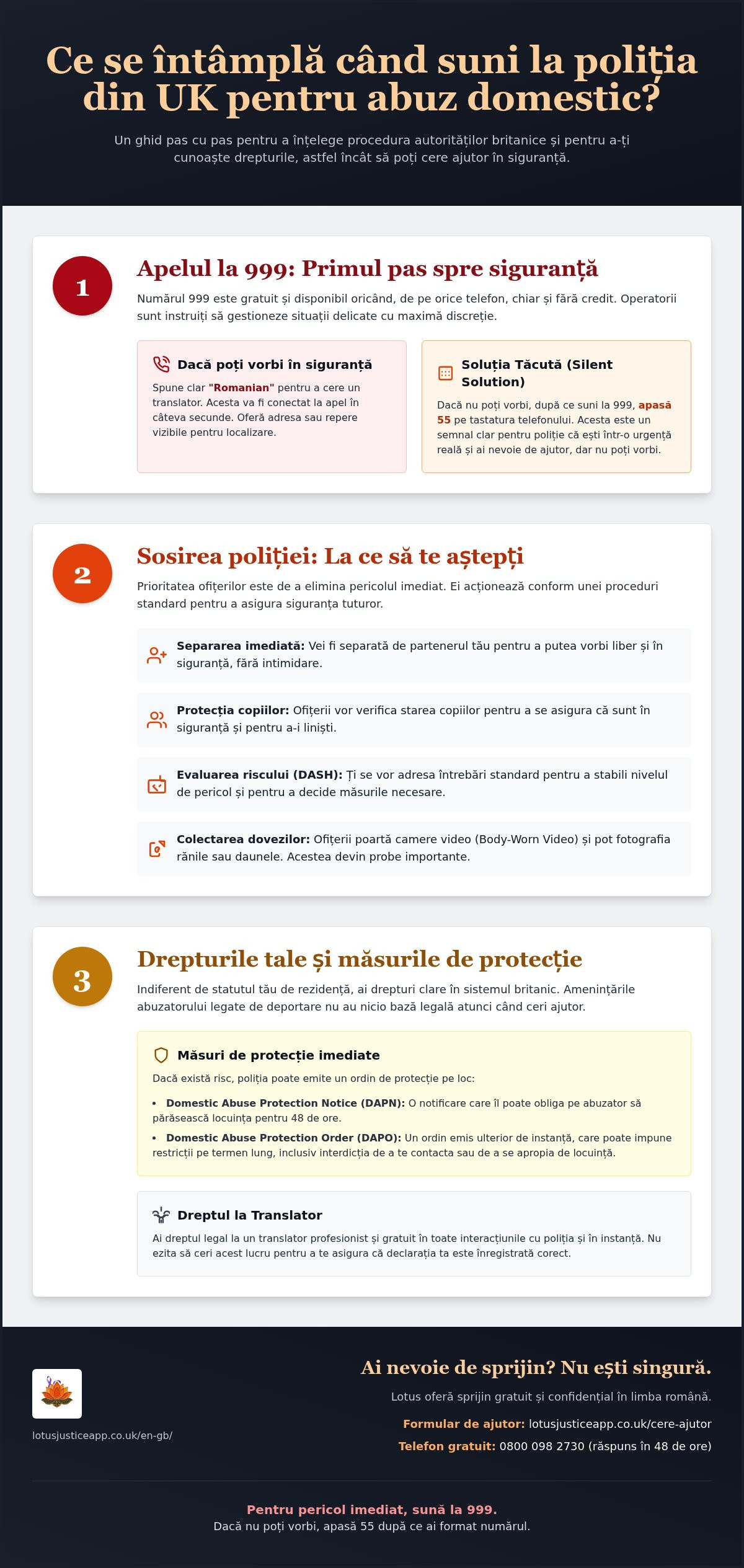
There are times when speaking aloud could put you in even greater danger. If you have managed to call 999 but cannot speak because the abuser is in the same room, the 'Silent Solution' system allows you to ask for help without making a sound. After you dial, the operator will try to communicate with you. If they do not receive a verbal response, you will hear an automated message asking you to press 55. Through this simple gesture, the police receive a clear signal that you are in a real emergency and need intervention, but cannot speak safely.
It is vital not to hang up after pressing 55. Stay on the line, even if you say nothing, so the operator can listen to what is happening in the background and try to locate your position. This method is essential for understanding what the UK police do for domestic violence after you call, as it triggers the dispatch of an emergency crew to your address without alerting the person next to you.
First interaction with the emergency operator
If you can speak but are worried about your English proficiency, do not let that stop you. As soon as the operator answers, clearly say the word 'Romanian'. The UK emergency system has access to telephone interpreters who can be connected in a matter of seconds. Until the interpreter is connected, try to provide the most important information: your location. If you do not know the exact address, describe what you see out the window, the name of a nearby shop, or visible landmarks. You can find a list of useful emergency phrases on our website to feel more prepared.
The operator will ask you a few short questions to assess the immediate risk. They will want to know if there are weapons involved, if children are present in the home, and if you need an ambulance. Your short and clear answers help officers come prepared to assist you in the most efficient way possible, ensuring their intervention is swift and safe for you.
Police arrival: What to expect when officers reach you?
When the police arrive at your address, their first priority is to ensure that the immediate danger has passed. Officers will immediately separate you from your partner, asking you both to stay in different rooms or even outside the home. This is a standard procedure, designed to provide you with a safe space where you can speak freely, without feeling intimidated by the abuser's presence. If children are present in the home, officers will go to see them to ensure they are physically well and to offer reassurance. It is essential to understand what the UK police do for domestic violence after you call that officers have a duty to protect you regardless of your residency status or English proficiency.
Risk assessment and immediate safety
Police officers will use a special assessment form called DASH (Domestic Abuse, Stalking and Honour-based violence). This is a series of questions about your relationship history, the frequency of incidents, and whether there have been recent threats. Their aim is to determine the level of risk you are exposed to. A police response inspection report shows that officers are increasingly well-trained to identify signs of coercive control, not just physical violence. If officers believe a crime has been committed or there is a high risk of harm, they may decide to make an arrest on the spot, even if you do not necessarily wish for this at that moment.
Initial statement and video evidence
Each officer usually wears a body-worn video camera, which is switched on during the intervention. The captured images and sound serve as independent and very strong evidence in court, especially if the abuser later denies the facts. Officers will take photographs of any visible injuries or damaged objects in the house. It is important to tell the truth about what happened, without trying to excuse the other person's behaviour. You are not to blame for their actions, and your honesty helps the police build a strong case for your protection. If you feel you need someone to listen to you and guide you through these steps, you can always contact us to ask for help confidentially.
The police will collect all this initial evidence to decide the next steps. Even if you are scared, remember that their role is to stop the abuse and prevent its recurrence. This first interaction is the foundation upon which your long-term safety will be built, providing authorities with the necessary tools to apply legal restrictive measures if the situation requires it.
Your rights in the UK justice system
Many Romanians fear that their lack of English or their residency status will limit their access to justice. The reality is that the British system offers clear protections to anyone experiencing abuse, regardless of how long they have been in the country or their English fluency. An essential aspect of what the UK police do for domestic violence after you call is the guarantee of total confidentiality. Your contact details, your new address if you have left home, or details about your workplace are protected by law and are not disclosed to the abuser during the investigation. Furthermore, if you were forced by the abuser to commit illegal acts, British law recognises that your actions were the result of coercion, offering you protection against self-incrimination.
Access to translation and interpreting
You have the legal right to a professional and free translator for all official police interviews or court hearings. It is a critical safety rule: never use children, friends, or family members to translate in front of officers. Professional translators are neutral, adhere to strict confidentiality rules, and know the legal terminology necessary for your statement to be accurately recorded. If you feel that the person translating is not faithfully rendering your words or is displaying an inappropriate attitude, you have the right to request the discussion be stopped and another interpreter requested. To better prepare before an official meeting, you can consult our resources, which explain the basic terms you will hear.
The Victims' Code explained
The Victims' Code is the official document that guarantees you a minimum set of rights in England and Wales. According to this code, the police have a legal obligation to inform you about the progress of the investigation at regular intervals. It is not your responsibility to constantly call for updates; the case officer must contact you to inform you if the person has been charged or if the investigation has been closed due to lack of evidence.
If the police decide not to send the case to court, you have the right to request a review of this decision through a procedure called the Victims' Right to Review. This means that another prosecutor or officer will check whether the initial decision was correct. If you feel that your rights have not been respected or that you have been treated without due respect, you can file an official complaint directly with the respective police force. These mechanisms are specifically designed to ensure that your voice is heard and that you receive the necessary support to rebuild your life safely, without the pressure of fear or uncertainty.
Investigation and protection measures after the police leave
The police leaving your home does not mean the end of the protection process. On the contrary, it is when long-term legal mechanisms begin to work to ensure your peace of mind. It is essential to know in detail what the UK police do for domestic violence after you call to feel in control of your situation, especially if the abuser has been arrested or asked to leave the home temporarily. Your safety remains a priority, and authorities have specific tools to maintain distance between you and the person who has harmed you.
Protection orders issued by the police
Immediately after the incident, the police can issue a Domestic Abuse Protection Notice (DAPN). This is an urgent notice that prohibits the abuser from approaching you or entering your home for a short period, usually 48 hours. During this time, the police go before a court to request a Domestic Abuse Protection Order (DAPO), which can extend these restrictions for a much longer period. If they violate any of these conditions, the police can arrest them again immediately. Breaching a protection order is a serious offence in the UK and can lead to prison sentences of up to 5 years, giving you the necessary time to decide your next steps without pressure.
Involvement of Social Services
Many Romanian women avoid reporting abuse due to fear that Social Services will take their children. We want to assure you that this is a dangerous myth that only serves the abuser. The role of social workers is not to separate families, but to ensure that minors grow up in a safe environment, free from violence. They collaborate with the police to help you stay with your children, offering you access to housing resources or emotional support. If you demonstrate that you are taking steps to protect yourself and them, social services will be your allies. They can even help you obtain additional protection from the local council or access emergency funds if you need to move.
The moment you decide to separate or report abuse is often the riskiest in the entire relationship. That is why it is vital to have a well-established safety plan for the period after officers leave. You do not have to go through this alone. Planning with a specialist worker can help you anticipate the abuser's reactions and know exactly what to do if they are released under bail conditions, such as a prohibition on contacting you in any form.
How Lotus Justice and Support Centre supports you after reporting abuse
After the officers leave and quiet settles in the house, you might feel overwhelmed by uncertainty. Emergency intervention is just the first step in a longer process of recovery and stabilisation. Lotus Justice and Support Centre was born precisely to be by your side at this stage, offering you a bridge between your vulnerability and the complex institutional systems in the UK. Understanding the procedures regarding what the UK police do for domestic violence after you call is essential, but you also need an ally who speaks your language and knows your rights as well as a local expert.
Legal and emotional guidance services
Our AI assistant is available 24/7 to offer you immediate and confidential information in Romanian. You can use this digital tool to ask questions about legislation or procedures without fear of being monitored, as it is designed to provide a safe information space. It can help you better understand your rights in the UK, from how protection orders work to your right to be treated with dignity by authorities.
In addition to technological support, our team offers emotional support through weekly groups and online psychological counselling. We know that the trauma of abuse does not disappear once the police leave, and cultural isolation can make the healing process even more difficult. Although we do not offer direct legal representation in court, Lotus Justice and Support Centre can guide you to verified partner organisations that specialise in defending the rights of Romanian citizens across the country.
Next steps for your long-term safety
Your long-term safety depends on careful planning and access to the correct resources. Our specialists help you create a personalised safety plan, adapted to your specific situation, regardless of the local authority you are in. This plan is vital because the risk can increase in the immediate period following separation, and collaboration with a specialist worker can make a difference. We support you in navigating your relationship with social services and understanding how you can access housing support or social benefits if you are forced to leave your home.
Our team at Lotus Justice and Support Centre has already processed numerous requests for help from various areas of the United Kingdom, demonstrating a high civic responsibility towards the Romanian community. If you feel lost in the British justice system or if you need clarity about what the UK police do for domestic violence after you call, do not hesitate to contact us. We are here to empower you through correct information and human solidarity.
If you need help now and want to speak to someone who understands your situation, complete our contact form to receive confidential guidance as soon as possible.
Your steps towards a life lived in safety
Choosing to ask for support is an act of immense courage, not weakness. Now that you better understand what the UK police do for domestic violence after you call, you can replace uncertainty with confidence that the British system has the necessary tools to protect you. You have the legal right to safety, to a translator who will ensure your voice is heard, and to restrictive measures that keep abuse away from you and your children.
The Lotus team is ready to offer you the emotional support and guidance you need to navigate this complicated process. We guarantee total confidentiality in accordance with UK GDPR standards and a response to your request within a maximum of 48 hours. You can contact us anytime via our freephone helpline 0800 098 2730 to discuss your options.
You deserve to live without fear, in an environment where you are respected and protected. Do not forget that in case of immediate danger, you must always call 999, and if you cannot speak, press 55 to alert the police that you need urgent intervention.
Frequently asked questions about police intervention in the UK
What happens if I call 999 and cannot speak English?
You can ask for help even if you do not speak English at all. As soon as the operator answers, clearly say the word 'Romanian' and you will be connected in a few seconds with a professional interpreter who will translate the conversation. If you are in a situation where you cannot make any sound, use the 'Silent Solution' method by pressing 55 after calling 999. This procedure is part of how the UK police handle domestic violence after you call, ensuring that the language barrier does not leave you without protection.
Can the police deport me if I report domestic violence in the UK?
No, the British police have a duty to protect you regardless of your immigration or residency status. The officers' priority is your immediate safety and stopping the abuse, not checking your visa or documents. The threat of deportation is a common form of control used by abusers to silence you. In reality, reporting the situation can open up access to specific forms of support, and our team can guide you to specialist legal advice to secure your status.
Will my children be taken away if I call the police for abuse?
This is a dangerous myth, as the purpose of social services is to keep children safe with the parent who cares for and protects them. When you report abuse, you demonstrate to the authorities that you are doing everything possible to ensure a protected environment for your children. Social services will collaborate with you to create a safety plan and provide you with the necessary resources, so you are not forced to remain in a risky situation for fear of losing custody.
What is Clare's Law and how can it help me find out my partner's past?
Clare's Law, officially known as the Domestic Violence Disclosure Scheme (DVDS), gives you the legal right to ask the police if your partner has a history of violence or abusive behaviour. You can make this request online or at a police station if you have concerns about your safety in the relationship. If the police hold information indicating a high risk, this will be disclosed to you in a strictly confidential setting to help you make informed decisions about your future.
What do I do if the abuser violates bail conditions?
If the abuser violates any bail conditions, such as a prohibition on contacting you or coming to your address, you must call 999 immediately. Breaching these conditions is a serious offence, and the police have the power to arrest the person again on the spot. It is essential to report any attempt at contact, whether it is a message on social media, a phone call, or their physical presence near your home.
Am I protected if I have no physical signs of violence, only emotional abuse?
Yes, you are protected by law even if there are no visible signs of physical violence. The Domestic Abuse Act 2021 recognises coercive control, emotional abuse, harassment, and economic abuse as criminal offences in the UK. If your partner controls your finances, isolates you from family, or constantly humiliates you, the police have a duty to intervene. These forms of abuse are taken very seriously and can be demonstrated through messages, witness statements, or officers' video recordings.
How much does a translator's assistance cost during a police interview?
The assistance of a professional translator is completely free and is a right guaranteed by the Victims' Code. The police are obliged to cover all costs related to interpreting so that you can provide a complete and correct statement in Romanian. You do not have to pay anything at all, nor do you need to bring your own translator; the authorities will use authorised services that ensure the neutrality and total confidentiality of all information you choose to convey during the official investigation.
Can I report abuse to the police anonymously in the UK?
Yes, you can provide information about an act of abuse anonymously through the organisation Crimestoppers, by calling 0800 555 111. However, to benefit from immediate personal protection measures, such as restraining orders, it is necessary to make a direct report to the police. If you choose to speak with officers, you can request that your contact details remain confidential from the abuser, ensuring they do not find out your location during the investigation into what the UK police do for domestic violence after you call.

Disclaimer
The information on this blog is general and educational. It does not constitute individual legal, medical, or psychological advice and is not a substitute for support from a specialist who knows your circumstances.
If you are in immediate danger, call 999. If you cannot speak, press 55 once connected.
For free, confidential support in Romanian, complete the form at lotusjusticeapp.co.uk/cere-ajutor or call 0800 098 2730. We respond within 48 hours.
Online safety: if you are using a device the abuser can access, clear your browsing history or use a private window. You can also access this site from a public library, at work, or on a trusted person's phone.
Lotus Justice & Support Centre CIC, company registered in England and Wales no. 17184809. ICO registration ZC144429.

